
Effective inter-agency collaboration is critical to the success of incident response operations, whether for day-to-day mutual aid or for large-scale situations such as wildfires, floods, and other natural or man-made disasters.
While coordination between agencies has been a challenge in the past due to communication barriers, inadequate resources, and lack of clear and concise information sharing, the advancement of accessible technology through First Arriving Dashboards is making it quicker, simpler, and more effective than ever before.
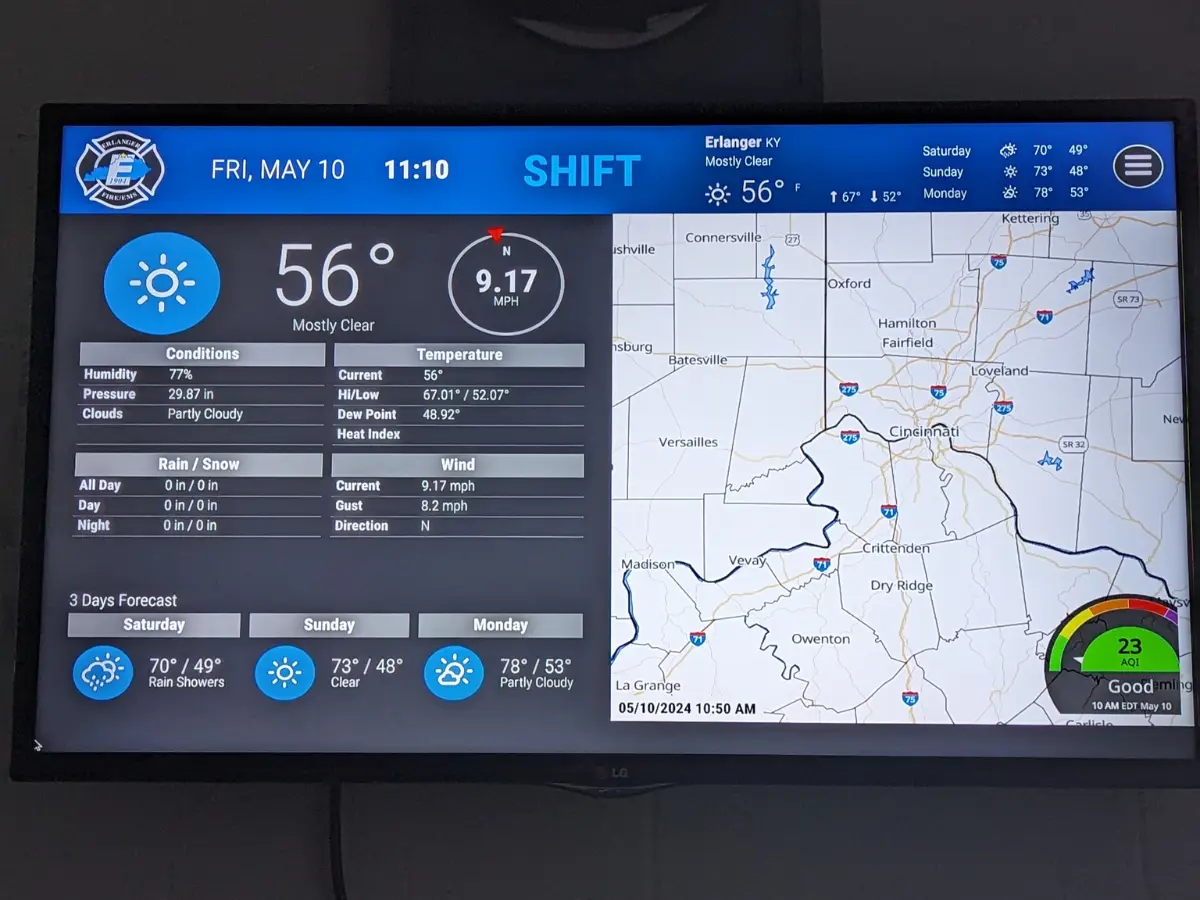
Now, fire departments can push out critical data across multiple agencies, with the ability to control which data is individual and which is shared across each agency’s large-screen dashboard displays.
Several neighboring Kentucky counties are now each highly connected after implementing First Arriving to coordinate their fire departments. Assistant
Chief Charles ‘Chuck’ Dietz of the Crescent Springs-Villa Fire Department spearheaded an agreement among several Kenton County mutual aid departments after seeing dashboards successfully implemented in Boone County to their west and Campbell County to their east.
“We share a couple of screens, and one is our staffing levels,” Dietz said. “We can say, ‘Oh, they’re at full staffing tonight,’ or ‘Oh, no they’re not.’” He added the shared page also shows streets closed, hydrants out of service, and training.
There are numerous additional integrations and features that fire departments can choose to share via First Arriving Dashboards for both collaborative pre-planning and for real-time communication during incidents.
Real-Time Communication:
First Arriving’s real-time communication channels make it easier for agencies to share information without having to translate data from different systems. This allows participants to immediately share incident overviews and updates with all involved agencies at the same time; enables live, cross-agency messaging and Zoom meetings; simplifies photo, video, and document sharing; and more. The ability to work together within a single platform reduces the risk of miscommunication or duplication of effort, and enables faster decision-making.
Multi-Agency Coordination:
When numerous agencies are working on the same operation, it can be challenging for incident commanders to coordinate all of their efforts and resources. First Arriving
Dashboards alleviate this challenge by allowing all participating agencies to access their combined, real-time staffing and equipment availability, resource tracking, incident locations, and other critical data. In addition, the large-screen format across agencies aids in team viewing and enhances the delivery of visual content such as pre-plan changes, mapping, and key response area updates. By effectively sharing information, agencies can make better decisions based on their shared knowledge, and optimize their combined operational efficiency.
Unified Information Sharing:
Before First Arriving Dashboards, agencies exchanged information by passing it from person to person by telephone, email messaging, or other methods. However, these steps take time, and hold the potential for error or misinterpretation. They can also result in agencies working from different data as they receive updates at different times. First Arriving Dashboards unify information sharing by providing a centralized platform where every participating agency views the same data at the same time, straight from the original source, such as a shared spreadsheet being updated in real time. With this capability, departments can make better-informed decisions.
Resource Tracking and Management:
During an incident, efficient management of resources including personnel, apparatus, and equipment is critical to an effective response. First Arriving Dashboards enable real-time tracking and management of resources, such as live mapping of vehicle locations and the sharing of staffing data. With real-time tracking, departments can optimize their strategic decisions and resource allocation, resulting in quicker and more efficient response operations.
Increased Situational Awareness:
First Arriving Dashboards enable a comprehensive view of the incident, providing participating agencies with a clear understanding of the situation’s evolution. The platform offers incident maps, hydrant locations, area hazards and pre-plan information, and additional relevant information such as changing wind and weather conditions, live traffic data and road closures, etc. This shared situational awareness not only optimizes efficiency, but increases safety and allows fire departments to get a full picture of developing situations in their area before they are potentially called.
Conclusion:
Collaboration has proven essential to the success of incident response operations. First Arriving Dashboards offer an innovative platform for real-time collaborative workflow between different agencies and departments. The result is a more efficient and effective operation, where all participants share the same knowledge and goals. First Arriving Dashboards empower agencies to work better together, making communities safer and more resilient.
In Campbell County, KY, Lieutenant Danny Hildebrand of the Central Campbell Fire District agreed that First Arriving Dashboards have assisted in decision-making by their incident commanders across the county.
“We are able to use it for a multitude of things,” he said, “from training, response information, communication to other departments, keeping track of information passed on from shift to shift, there is so much we use it for.”