
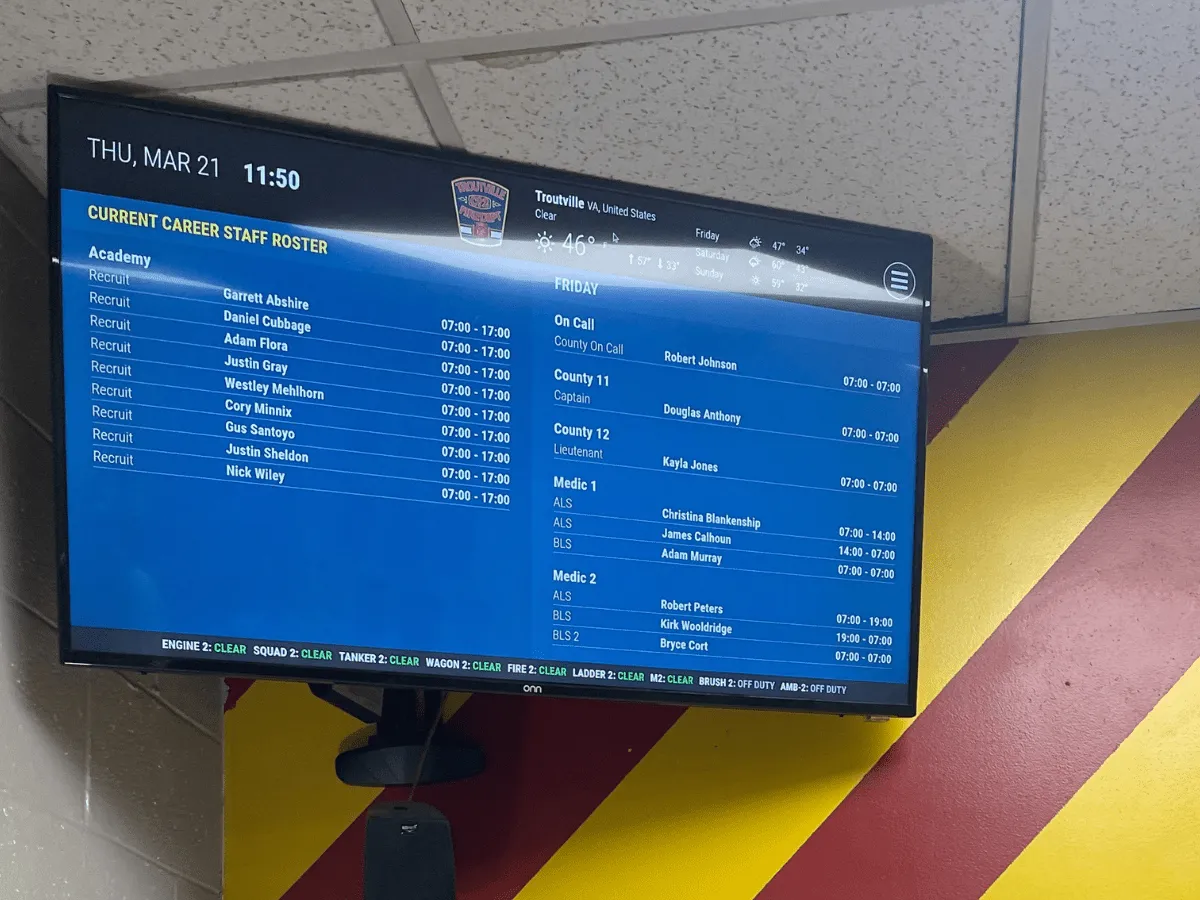
When the Troutville Volunteer Fire Department in Virginia sought a new system to manage their data and communication, department leaders took the opportunity to not only improve access to what they already had, but to envision new ways to use data to improve their operations.
“When we first found out about First Arriving it piqued our interest,” said Chief Zach Beckner, who went on to implement dashboards at his department. “I’m a technology guy. I love the latest technology, and so a couple of us here really got in to see the demo and fell in love with the technology that we could bring here to Troutville,” he said.
The Troutville Volunteer Fire Department protects approximately 12,000 people living in an area of 56 square miles in the Blue Ridge Mountains of Virginia, according to the department’s website. With more than 400 fire calls each year, it’s the busiest fire department in Botetourt County and serves one of the fastest-growing areas in Western Virginia and the Roanoke Valley.
Before the dashboards, Beckner said, the department relied on communication via email, clipboards, and a lot of paper on the walls—and it was easy for things to get missed.
“Since our implementation of the dashboards, we’ve really been able to fill in the gaps where we had breakdown in our communication,” he said.
“As you walk through the station, you can glance at those dashboards and you get those training announcements. You can see the calendar and events for the day. And all the other integrations we have tied in for response keep everything front of mind.”
However, some of the biggest impacts of the technology were unexpected, Beckner added, thanks to integrations they didn’t initially foresee adding.
“One of those examples is flood gauges that we have in our first due area,” he said.
“To be able to monitor those in kind of real time from the Weather Service, we can kind of keep a picture on what those gauges are looking like in times of severe weather.”
One of his favorite features, Beckner added, is some of the CAD integration they did, such as capturing burn permits in CAD, which makes it quick to see if there’s been a burn permit issued in an area where they have a call.
“I think the crews appreciate most is some of the response items that we have coming to the dashboards like our traffic cameras, Active911 integration. We’ve got 15 miles of Interstate 81, so to be able to quickly look up to those cameras that we have prepositioned on the dashboards, see if we can, you know, preview that incident or kind of pinpoint where that is before we leave the station, is a huge benefit for us.”
As many other First Arriving dashboard users have discovered, the system can also be beneficial for communication between departments.
“There’s a lot of collaboration that we’ve done with the dashboards with other departments here in the county,” Beckner said.
“We share a common slide deck that has all of our countywide training announcements and other events. We also share several calendars as well as a lot of our scheduling integration.”
“Advice I would give other departments that are interested in implementing dashboards are really to think outside the box,” he said.
“Think about all the different information that you can have at your responders’ front of mind in the station that helps them perform better and be most effective on the calls that they respond to.”
With so many options for how departments can customize dashboards to suit their unique circumstances, Beckner suggests being open-minded.