In the fast-paced world of firefighting, effective communication is critical for the success and safety of fire department operations. However, fire department leadership often faces challenges in maintaining clear and efficient internal communication. These challenges can result in delays, confusion, and potential risks. In this article, we will delve into the importance of internal communications for fire departments and how First Arriving’s dashboards provide a powerful solution to bridge communication gaps and enhance operational effectiveness.
In an emergency response environment, communication is not only essential, but its delivery must be immediate and seamless in order for fire department leadership to continuously keep their teams informed, updated, and aligned to ensure a coordinated and swift response. Internal communications play a vital role in the following areas:
Incident Management:
During an incident, clear communication is essential for effective coordination among various personnel, apparatus, and agencies. Accurate and timely communication ensures that everyone is aware of incident details, objectives, and progress, enabling a synchronized response.
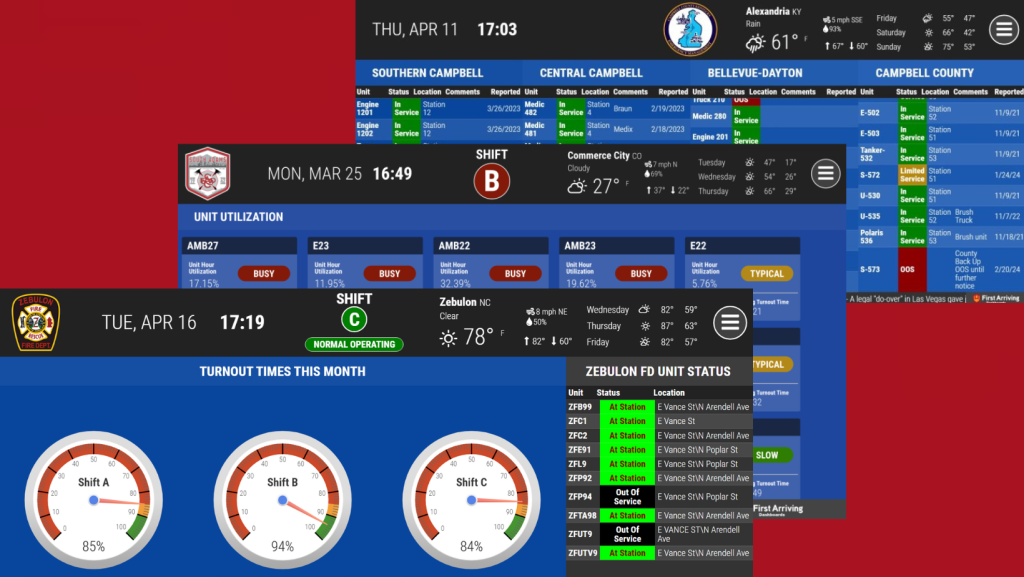
The Campbell County (KY) Office of Emergency Management used to rely on email, telephone, text messaging, and social media for daily communication with ten fire departments in their county. They needed to put a better system in place to manage preparedness efforts and the delivery of emergency plans and resources in case of a disaster or other major emergency.
The First Arriving digital dashboard platform now allows the OEM to stay in touch with the county fire departments and share information in a way that is easy, efficient, and beneficial to public safety. “We can see each fire department page, and they can see ours,” said Deputy Director James Sparks. “They can see our equipment and the resources available to them.”
Training and Education:
Proper training and ongoing education are paramount in maintaining the highest standards of service in firefighting and EMS. Internal communications platforms facilitate the efficient dissemination of training materials, updates, and best practices, ensuring that all personnel have access to the latest knowledge in the field.
Fort Mill (SC) EMS finds many uses for its First Arriving dashboards, including pushing out reminders to renew paramedic cards, posting meeting information, and announcing training topics. Their future plans even include using the dashboards to run training videos. However, they had another reason they sought out the dashboard program.
As a training ground for community college EMS students, Fort Mill sees a steady flow of new faces, which used to make it challenging to track everyone’s qualifications, said Deputy Chief Bill Moran. “We have a lot of volunteers and people new to EMS,” he said. “One way things were kind of disjointed with new people coming in, was the crew wouldn’t necessarily know where they were in their progression.” Now, each member’s status is shown on the dashboard, to help crews – and the new members themselves – keep track of their status and qualifications.
Policy and Procedure Updates:
Fire departments operate under a framework of policies and procedures that need to be effectively communicated to ensure compliance and consistency across the organization. Internal communication platforms streamline the distribution of policy updates, ensuring that all personnel receive the necessary information promptly.
Under outdated systems, it’s all too easy for important communications to be buried or missed. “It was a death-by-email environment for us,” said Kevin Kellar, IT Manager for the South Adams County (CO) Fire Department. Before First Arriving, the department used individual and all-members email as the priority means of communication for everything from SOPs to birth announcements, he said. “Firefighters do not check their mail on their days off so a lot of what was being sent out was not retained.”

The impact of moving communications to the dashboard system has been huge, Kellar said, and has provided options for how to present information. The fire chief’s quarterly address is now filmed and then loaded into the platform to run.
Resource Allocation:
Effective internal communications enable fire department leadership to convey resource needs, such as equipment, personnel, and vehicles, to ensure proper allocation and efficient response capabilities.
When Assistant Chief Charles ‘Chuck’ Dietz decided to implement a dashboard at the Crescent Springs-Villa (KY) Fire Department, he coordinated with several neighboring departments to get on the same system, allowing them to share information and improve their ability to work together in the real world. The need to communicate staffing levels became especially apparent during COVID-19, he noted, when he decided to get the system.
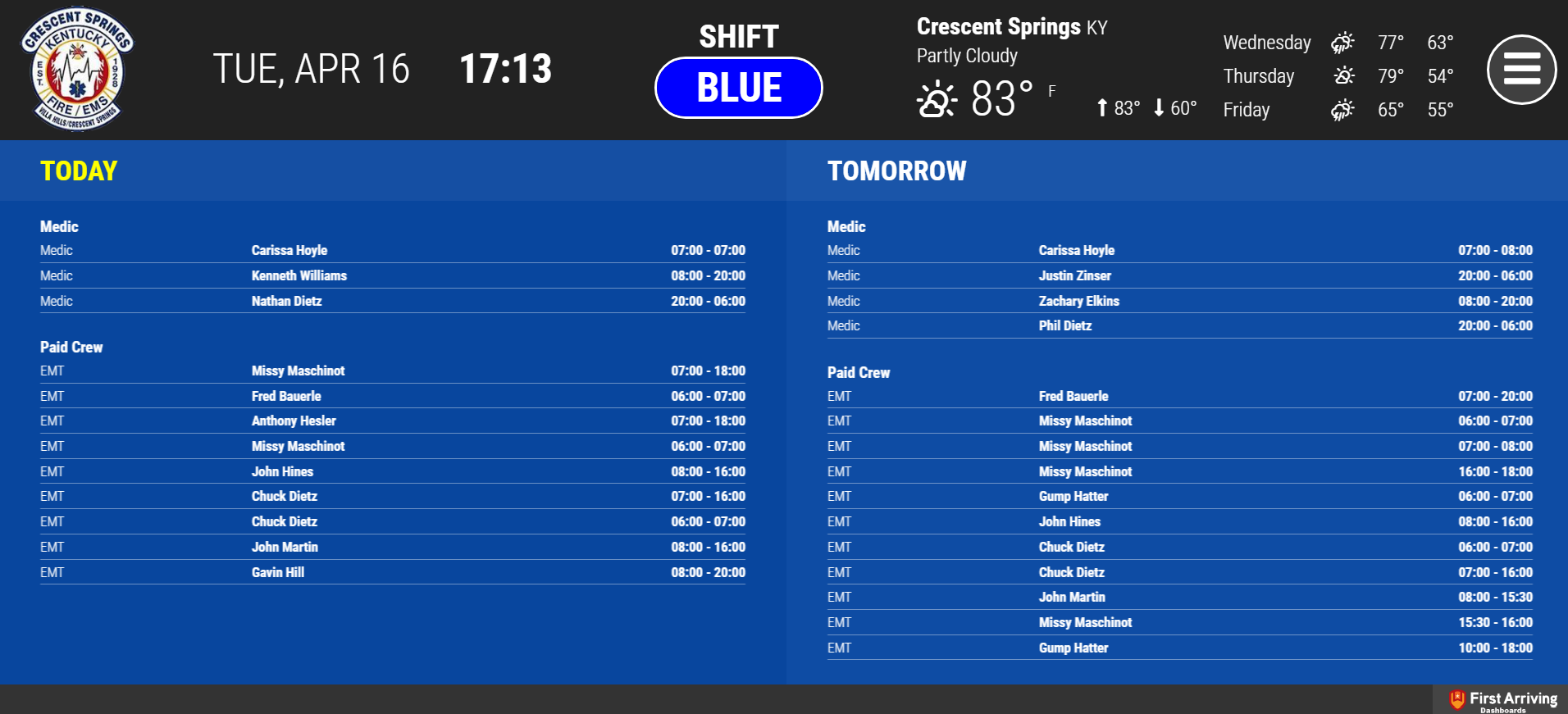
The four departments that decided to join forces through First Arriving dashboards each have their own individualized dashboard display, with a section that is shared across all those participating. “We share a couple of screens, and one is our staffing levels,” Dietz said. “We can say, ‘Oh, they’re at full staffing tonight,’ or ‘Oh, no they’re not.’” The shared page shows additional information such as streets closed and hydrants out of service, he added.
Centralized Communication Hub:
First Arriving’s dashboards provide a centralized platform for fire department leadership to consolidate communication channels. This eliminates the need for multiple communication methods, such as email, phone calls, and paper-based methods, streamlining communication and reducing the risk of missed messages.
“Prior to the implementation of dashboards, we were relying on emails and we noticed gaps where people weren’t getting messages,” said Trig Morley, Battalion Chief of Community Preparedness and Special Operations Johnson County (KS) Fire District 1. “It seemed that folks had to log into at least three different apps to increase their situational awareness for the day.”
Now, First Arriving dashboards allow for important information to be streamlined into one product that is accessible to all personnel.
Real-Time Updates and Notifications:
With First Arriving’s dashboards, fire department leadership can quickly disseminate critical information, updates, and alerts in real-time. Automated notifications ensure that all personnel receive the necessary information promptly, fostering faster response times and improved situational awareness.
Keeping critical information in front of its firefighters is a vital task that Hastings (NE) Fire Rescue sought to improve. Feedback from firefighters led Fire Chief Brad Starling to look at how digital dashboards could help. In their old system, he communicated by email and by putting together a monthly report – which meant the information was already old by the time people saw it.
The department wanted the ability to see live data all the time and to communicate that information in a way that was more effective, which is where First Arriving dashboards came in. “Having the staffing showing and the ability to display a call, as a call comes in, with a map was very beneficial,” Starling said.
Enhanced Collaboration and Documentation:
The dashboards enable seamless collaboration among team members, allowing for the sharing of documents, incident reports, and important announcements. As a result, fire department leadership can foster a culture of knowledge sharing and ensure that all personnel are working from the same page.
South King (WA) Fire and Rescue previously relied on email, SharePoint, and logbooks as their primary means of communication with battalion chiefs. However, when Assistant Fire Chief Kevin Crossen moved from Operations to Planning and began working on the department’s accreditation and means of communication, he learned they were struggling and looking for a way to share information that would be easily seen. “We were all looking for different ways to communicate,” Crossen said.

The visual appeal of First Arriving’s dashboards was the key in solving the communication problems for South King. It put their department’s communications in one place and allowed them to add additional digital integrations to further optimize their communication – all in a display that no one could miss. “First Arriving has been wonderful. The biggest plus to your product is the visual presentation,” Crossen said.
Actionable Data Insights:
First Arriving’s dashboards provide powerful analytics and reporting features that enable fire department leadership to track performance metrics, identify trends, and make data-driven decisions. This empowers leadership to continually improve operations and optimize resource allocation based on actionable insights.
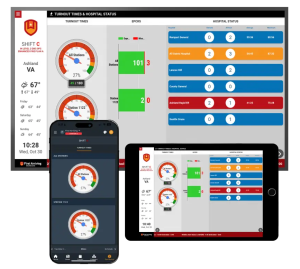
As Zebulon (NC) Fire Department’s Fire Chief Chris Perry discovered, gaining actionable insights empowered not only his leadership, but the department’s entire workforce. “I was sending an email at the end of each month with each shift’s past month’s turnout times. Now, with the turnout time indicators (gauges) that reflect the turnout time of the first-out units, they can see this as each call occurs,” he said.
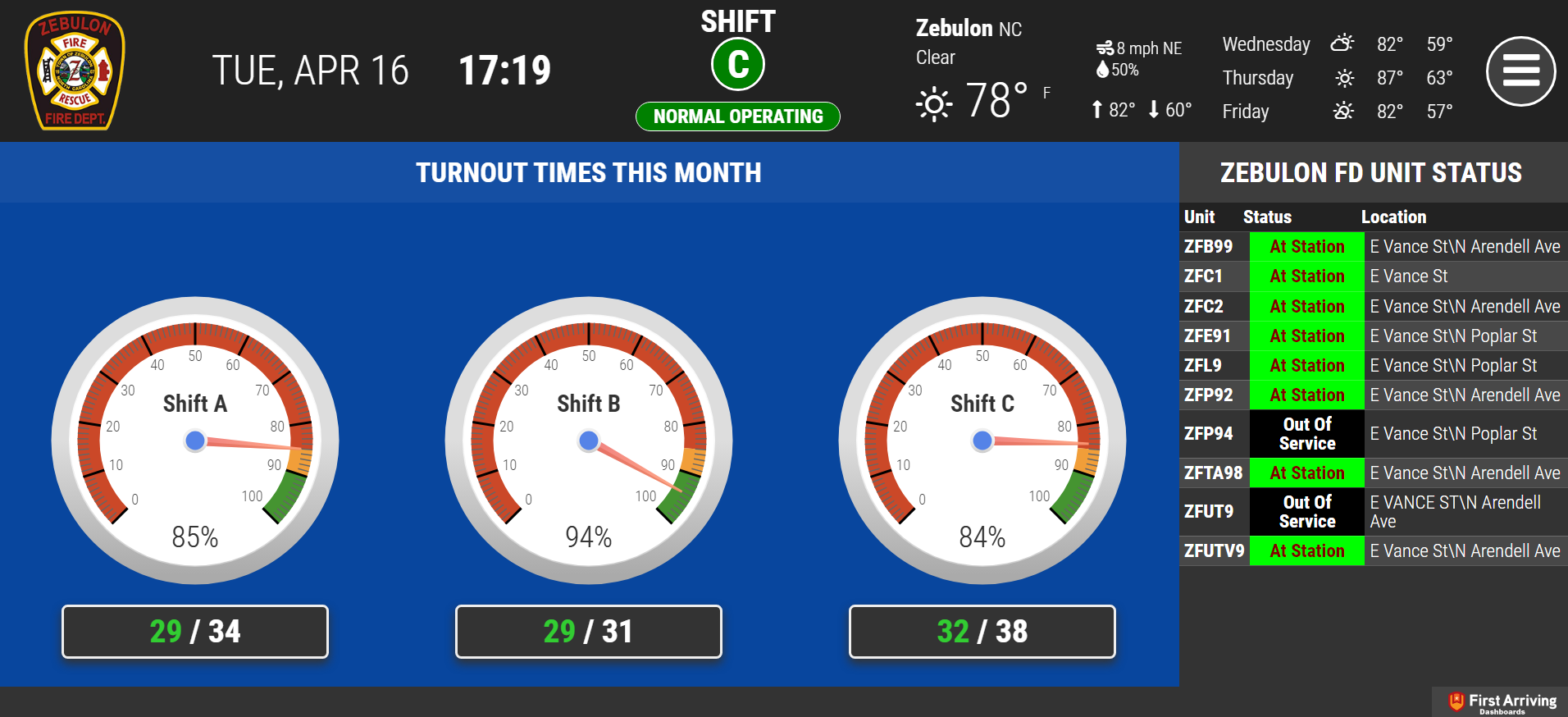
“It has created competition among the three shifts. Competition has been huge as shifts try to outperform each other. We exceeded our turnout goal for the first-time since tracking the information and are on track to continue to exceed goals,” he added.
Efficient internal communication is the backbone of a well-functioning fire department. First Arriving’s dashboards offer fire department leadership a powerful solution to overcome communication challenges and enhance operational effectiveness. With centralized communication hubs, real-time updates, and actionable data insights, fire department leadership can revolutionize their internal communications and set their department up for continued growth and success.