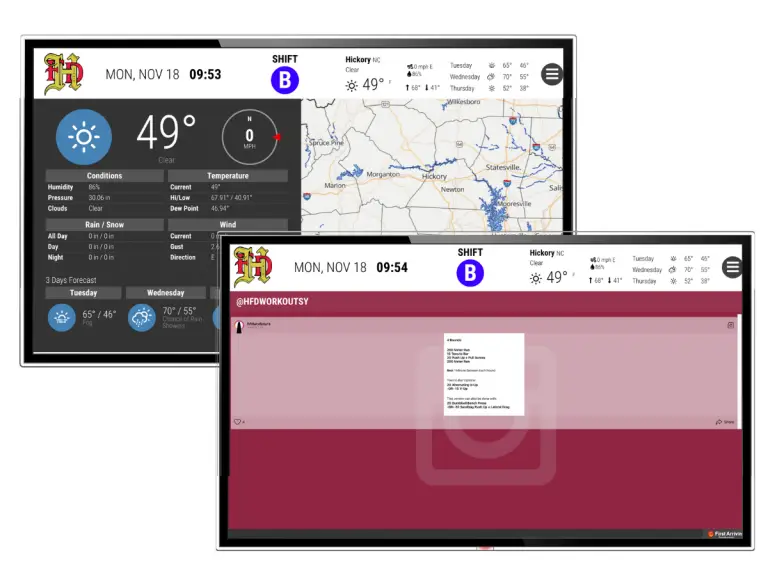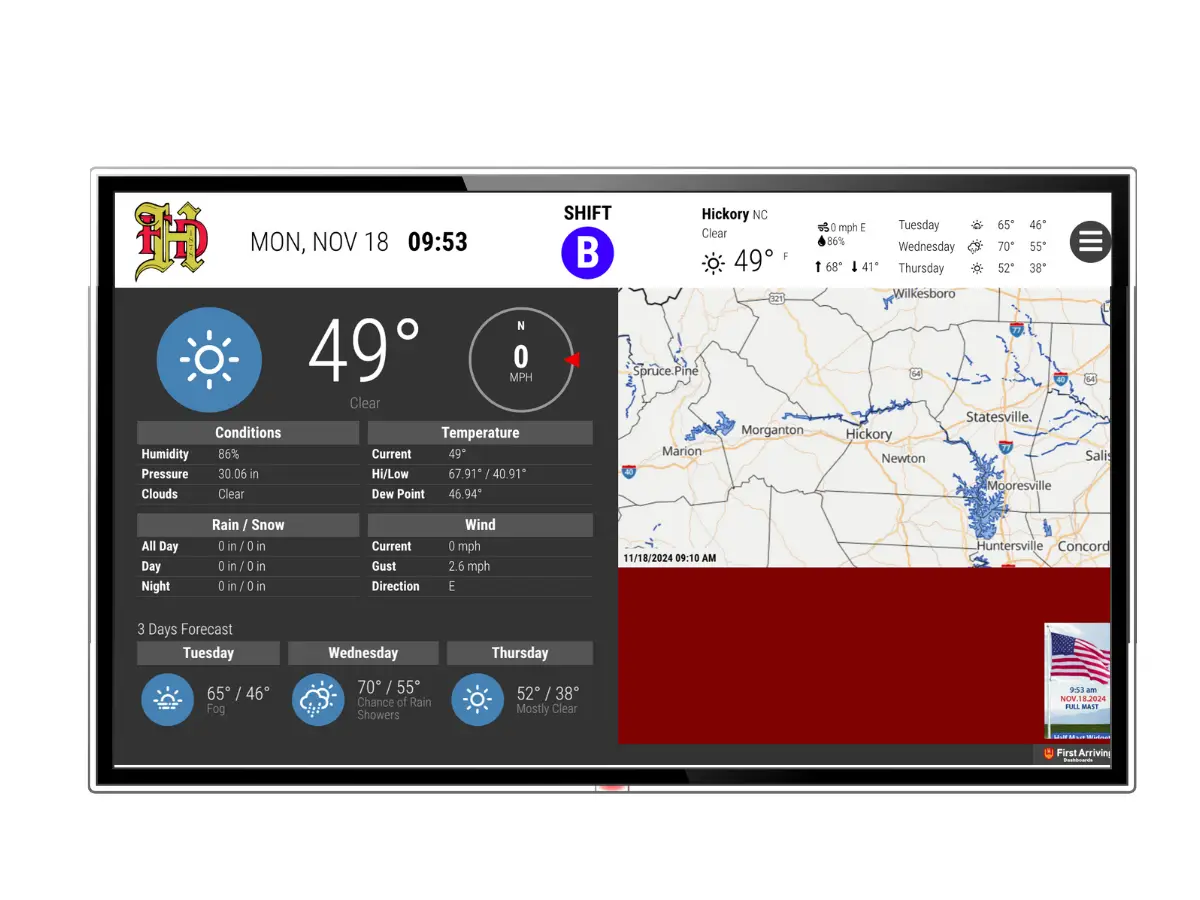
The Hickory, N.C. Fire Department implemented dashboards by First Arriving to help them track analytics for accreditation–and then saw additional positive impacts beyond their expectations, according to Capt. Marcus Scott, Fire Department Accreditation Manager.
The department first learned about dashboards in 2019 at a trade show and had the system up and running in their stations by the beginning of 2020, Scott said. The department has seven fire stations and is fully staffed at 139 firefighters and support personnel. It serves a city spanning 30 square miles with about 43,000 residents and a daytime population of 170,000.
“We were looking for solutions at the time because we were struggling to visualize some our analytics,” Scott said.
Their previous system left a lot to be desired, he said, and they found it inefficient when trying to pass along information from shift to shift. The process relied on a lot of printing and a lot of emailing reports and documents.
“We were really struggling. There was a lot of what I call treading water,” Scott said.
Department leaders were sold on the dashboards because they keep everything from metrics to calendar events to the weather permanently on display. “It’s constantly scrolling through and it can’t get static because it’s constantly just rotating,” Scott said.
This keeps information readily available and top of mind, unlike processes that require individuals to seek it out.
“As long as somebody’s got to physically go to a computer and log in and go to whatever the system is, you’ve already got a hurdle there that’s going to impede progress,” Scott noted.
The department now has one or more dashboards located in every station. The system, once installed, did help the department reach its goal of accreditation, Scott added.
“It was a big cog in the wheel, for sure,” he said, “mainly by making it possible to track everything required.”
There are 250 different performance indicators in the accreditation model, he noted, so the accreditation process pushed them to better track performance goals including call processing times, turnout times, and response times, using the dashboard system.
“It helped with being able to see that, hey here’s where we’re at today, and then setting that goal for improvement, and then monitoring the improvement towards that goal over a year’s span,” Scott said.
The department is now in its fifth year of monitoring improvements and can see clear trends, Scott added. “We’re kind of moving the needle forward a lot of ways,” he said. What they didn’t expect was just how effective it would be to simply have these metrics on display.
“We saw a tremendous improvement in our turnout times, and it wasn’t because we sent out our turnout times to everyone and said, well, your turnout time is this, and you should improve that,” Scott said. “We didn’t say a word. We didn’t go and browbeat folks or tell them you need to get better. We literally just implemented the dashboards, and said here’s your turnout times.”
But with data on display for each station and shift, things began to happen, Scott said.
“Once they started to see those things side by side, the competitive nature of most firefighters kicks in and we saw a tremendous improvement from just pushing the data out there and not saying a word.”
It’s the simplicity of the system and its most basic features that have made it a hit for the department, Scott said, including the ability to show static slides that can be updated with things like new personnel and birthdays, as well as the training calendar, training schedule for the day, weather, certifications that are expiring, etc.
Another particular favorite is the map shown with incident notifications.
“It kind of gives you a little more situational awareness of hey, I may be across town at Station 2 but Station 3 just got dispatched to a major incident,” Scott said. “If this becomes a second alarm response, we already know where we’re going, what we’re going to, and things like that.”
Staff have also liked to see that incident alerts can now come to them faster via their dashboard system, which they have tied in to Active911.
“In a lot of cases that response is actually coming prior to any kind of a tone or alerts from dispatch, so we’re getting some of those ahead of time,” Scott said. It can be even faster than their cell phone alerts, he added, which require the data to go through the cellular network or wifi.
For the future, the department is still hoping to get full integration with their county CAD system, Scott said, due to technical requirements needed on the county’s end. While fire departments may run up against some limitations like this depending on their circumstances, Scott said the department has appreciated First Arriving openly discussing and working through these details.
“We work with a lot of companies and vendors over the years, some very, very large,” Scott said. “I don’t know the exact size of First Arriving, but it always felt more like a family atmosphere. It kind of had that mom and pop type feel, that we’re not just a number on someone’s sheets or CRM report, that they’re calling us and wanting to set up a meeting to see how we’re doing and how they can improve working with their support folks. Even the sales folks–they’re very honest with here’s how this works, here’s what we need to make this happen, if you don’t do this then you won’t get this result.”
Scott’s advice to other departments that want to build a dashboard system is not to try to do it alone. They should consider the time it takes to understand and develop some of these tools and to get them working together and displayed in a way that meets the department’s needs.
“It’s not necessarily the best use of my time, so if I can find something–in our case that was First Arriving–and they can handle that task for me so I can focus on some of the other areas of the department, and not have to worry about the analytics, it just makes my job a lot easier.”