
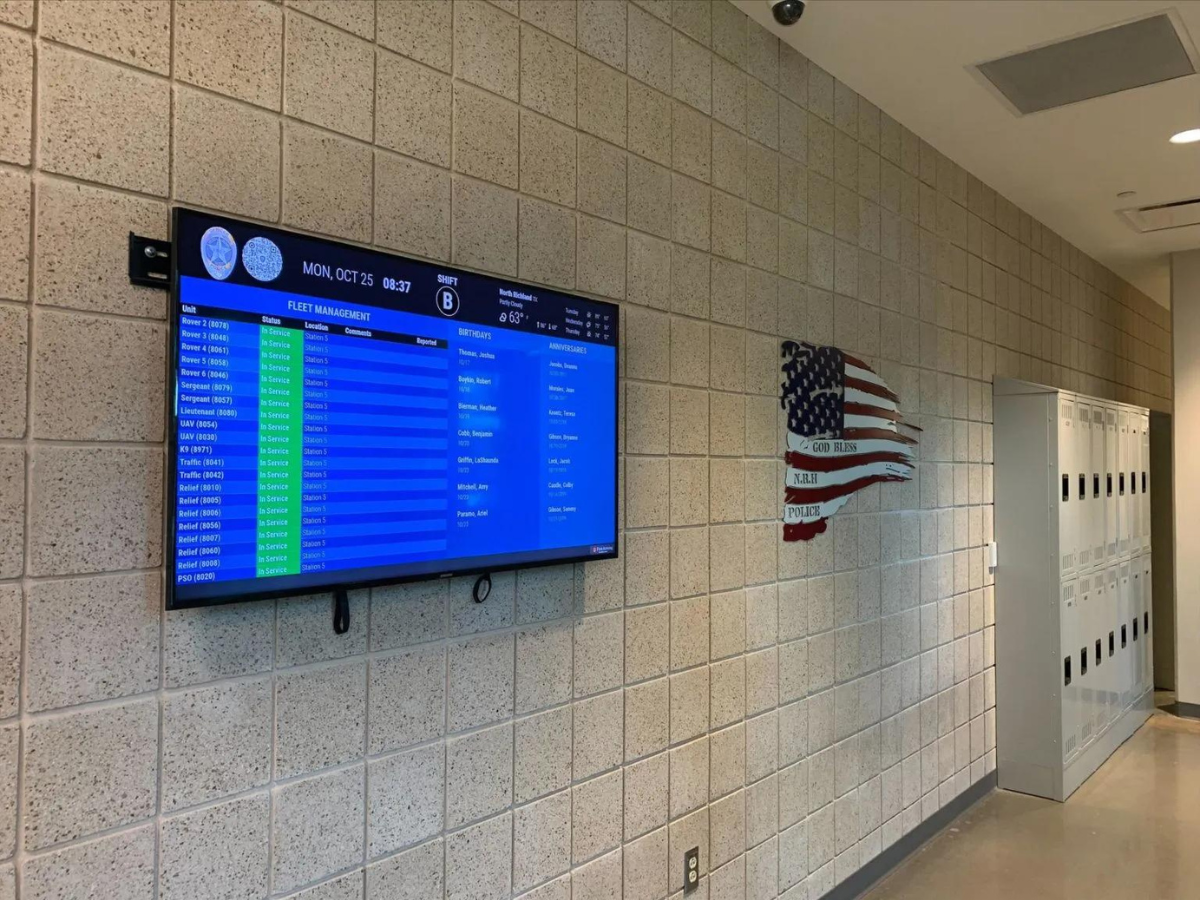
As software tools become indispensable in helping law enforcement agencies increase their efficiency and effectiveness, departments are facing the question of how to best manage and communicate their data. That’s where First Arriving Dashboards can offer a powerful and yet simple solution to streamline and display information on large screens across all of a department’s stations and shifts, keeping all staff informed and on the same page for better awareness and collaboration.
“First Arriving’s Dashboards have improved our department’s internal communication and allow us to dedicate the critical resources necessary to best serve our community,” said Capt. Mike Johnson, City of Fishers (IN) Police. “The displays equip our officers with the information they need when they need it.”
Perhaps most importantly, departments can customize their choice of product integrations, features, and dashboard appearance to address their specific needs, and change them over time as their needs continue to evolve. The most popular uses include the display of incoming incident data, agency statistics and goals, scheduling, announcements, and more. The options are far-ranging and include more than 125 software tools to enhance the following needs:
- Real-Time Intelligence
First Arriving Dashboards provide a centralized platform for managing and sharing critical incident information, including locations, status updates, alerts, and resource availability. Improve your staff’s situational awareness as well as their speed in decision-making and responding to incidents, with more accuracy and fewer risks. In addition to incident data, real-time traffic updates and weather information are among the most in-demand tools to provide personnel with key information at a glance. - Collaborative Incident Response
Effective incident response often requires collaboration among multiple agencies and teams. First Arriving Dashboards provide an effective way for law enforcement departments to collaborate seamlessly with other agencies, first responders, and public safety stakeholders. By sharing data, messaging, and incident tracking capabilities, dashboards enhance communication across multiple groups, leading to better and more efficient responses to incidents. Tools can include real-time Zoom meetings, displayed via large screen dashboards to easily address teams. - Comprehensive Resource Management
Law enforcement departments often require efficient resource management to cope with a wide range of incidents and simultaneous events. First Arriving Dashboards offer effective resource tracking and management tools, allowing departments to monitor and deploy resources efficiently, including personnel, equipment, and vehicles. Ensure your resources are allocated when and where they’re needed most, and display resource availability for staff as needed. - Real-Time Incident Mapping
First Arriving Dashboards offer powerful mapping capabilities, allowing law enforcement departments to visualize incidents in real-time. Through geospatial analysis, the dashboards can help departments identify areas of concern, visualize incident locations and hotspots, and plan response strategies based on current data. This spatial awareness enhances incident response efficiency, and most importantly, safety for responding personnel. - Enhanced Data Analytics
Data analytics have become essential for law enforcement departments to extract vital insights from large volumes of information. First Arriving Dashboards offer advanced analytics capabilities, allowing departments to visualize trends and analyze activity. With predictive analytics and machine learning, dashboards can help law enforcement agencies optimize the use of their data, as well as effectively share it with staff. Rather than disappearing under buried emails, vital data can remain top of mind for staff for as long as necessary as it cycles through a department’s large-screen dashboard displays. - Improved Operational Efficiency
First Arriving Dashboards can help law enforcement agencies optimize their management processes, allowing staff to make the best use of their time. The platform automates tasks such as documentation, reporting, and data analysis, reducing the workload for personnel on the ground. The platform’s intuitive interface and features are also user-friendly, allowing personnel to get up and running with it quickly.
Finally, beyond helping departments to optimize so many facets of their communication and collaboration, many departments find that dashboard technology actually helps them add a more personal connection among members. Leadership can use it to showcase new personnel, post recognitions such as work anniversaries, awards, and promotions, as well as personal announcements such as birthdays.
The digital dashboard platform of the Brainerd (MN) Police Department includes integrations for email, Google Sheets, Google Slides, Outlook, traffic cameras, Facebook, Twitter, and the department website. Their main goal is to make the incoming shift aware of vital information—as well as more connected.
“A lot of community event stuff, reminders for patrol requests also go up. We recently did a birth announcement for one of our officers,” said Lieutenant Mike Kulzer.
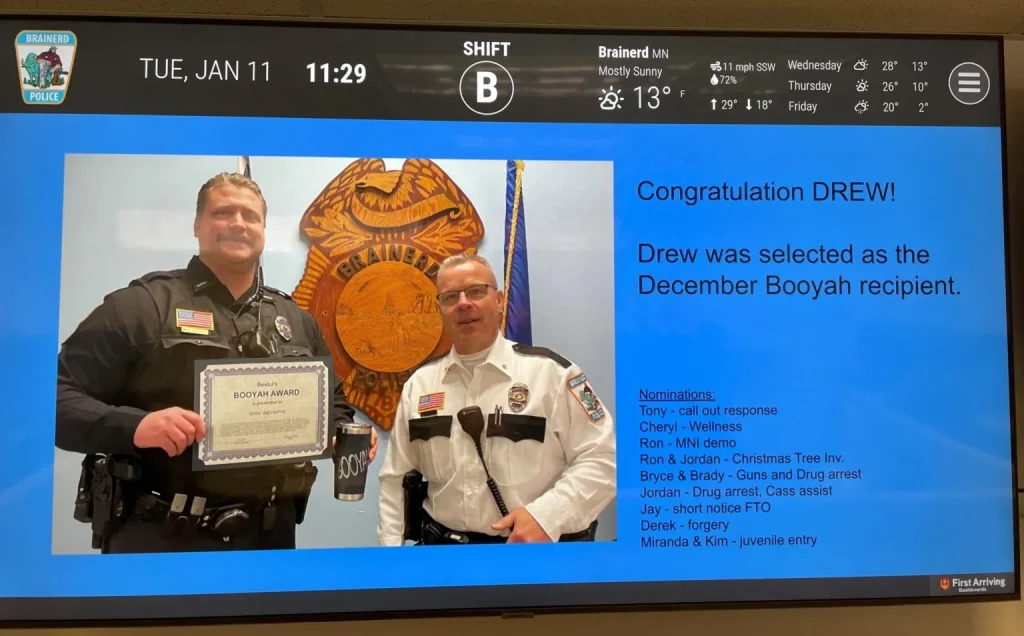
Kulzer said in the past, all the department used to rely on for communication among officers and staff was email and a whiteboard in the patrol office. “This is definitely more eye-catching,” he said.