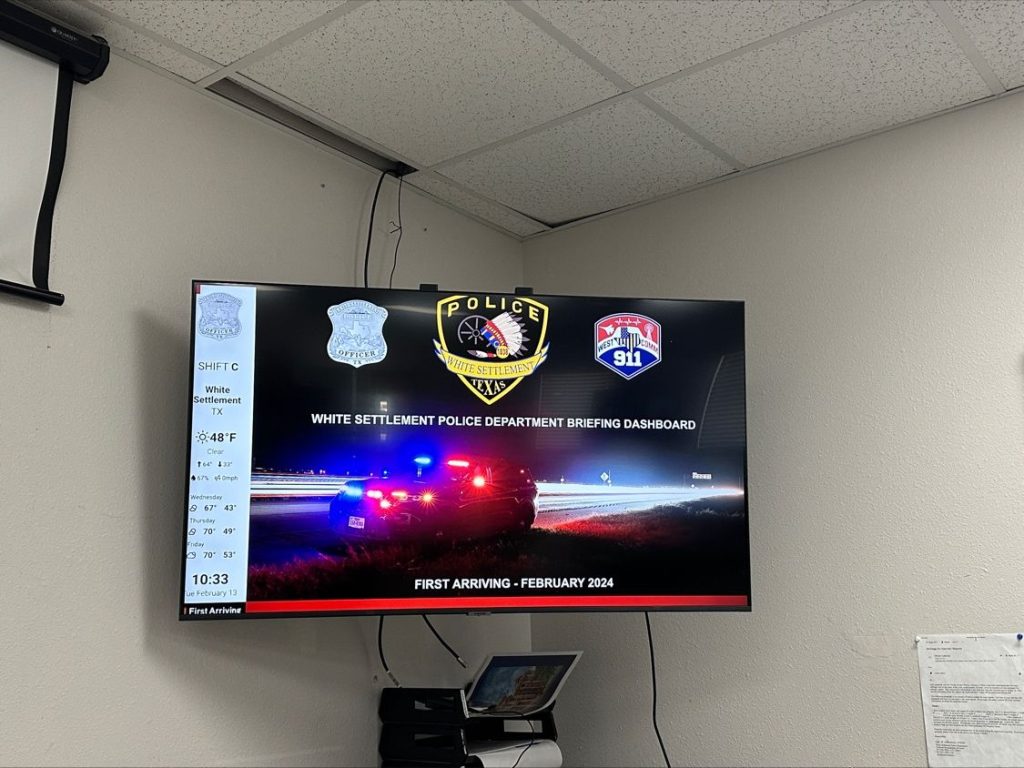
The White Settlement Police Department in Tarrant County, Texas holds a unique role given its location as a northwestern suburb of Fort Worth, where it not only serves its city of 21,000 residents, but also two military facilities. Its staff of 58 needed to strengthen their internal communications and turned to First Arriving Dashboards as their solution.
“We are the only police department in the nation that serves as a backup patrol agency for Air Force Plant 4, which is operated by Lockheed Martin, and the Naval Air Station Joint Reserve Base Fort Worth,” said Chief Christopher Cook. “So our officers are issued military IDs to access both facilities, and we supplement U.S. Navy Police on the base side, and we supplement Lockheed Martin’s force protection services on the production plant side.”
Cook is originally from White Settlement but spent 20 years serving in Arlington, TX, most recently as a deputy police chief, before coming home to White Settlement as chief in 2022. He had noticed in his previous role that the use of PowerPoint slides alone during briefings was of limited effectiveness.
“We would rarely update them, and as you know, if you don’t update, the people quit looking at them,” he said. “It wasn’t the most ideal way to communicate or reinforce what was being said in briefings.”
When he transitioned to White Settlement, he learned of a new solution from a friend working at that time for the city of North Richland Hills, he said, who explained that they were using First Arriving Dashboards—a system initially built with fire departments in mind, but also well suited to police departments.
“She showed me how they were using it and it really piqued my interest,” Cook said. “So I reached out to First Arriving, I got a demo, and the rest is history.”
Cook implemented the digital dashboards in all of his department’s work groups, including dispatch services, their administration suite which includes criminal investigations, and their patrol briefing room. With all of those strategic areas covered, they’re able to reinforce important messaging, he said.
But not all of the messaging is serious, Cook added.
“A lot of times we’re wishing people happy birthday or highlighting work anniversaries, or we’re giving kudos, or things in that nature that just kind of reinforce that we care as a police department,” he said. “And we want to take away from the table someone saying that they didn’t know what’s going on.”
What sold Cook on this particular system, he said, was the ease with which they could change the content on a web-based platform versus having to log into proprietary software. Now, as part of the department’s weekly command staff meeting, they discuss what to update on the dashboards to keep it fresh and relevant. “Normally we leave content up for about a week or so, because our officers are on 12-hour shifts and some of them have four days off in a row. So leaving up the content for about a week ensures that pretty much everybody will see what is posted,” he said.
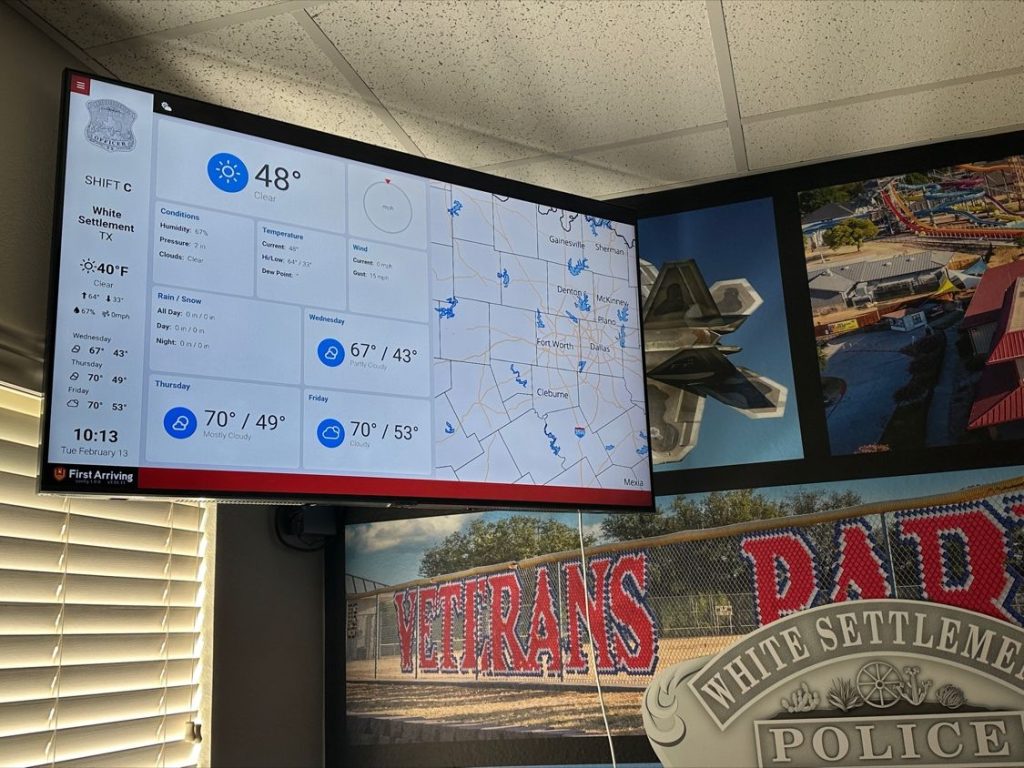
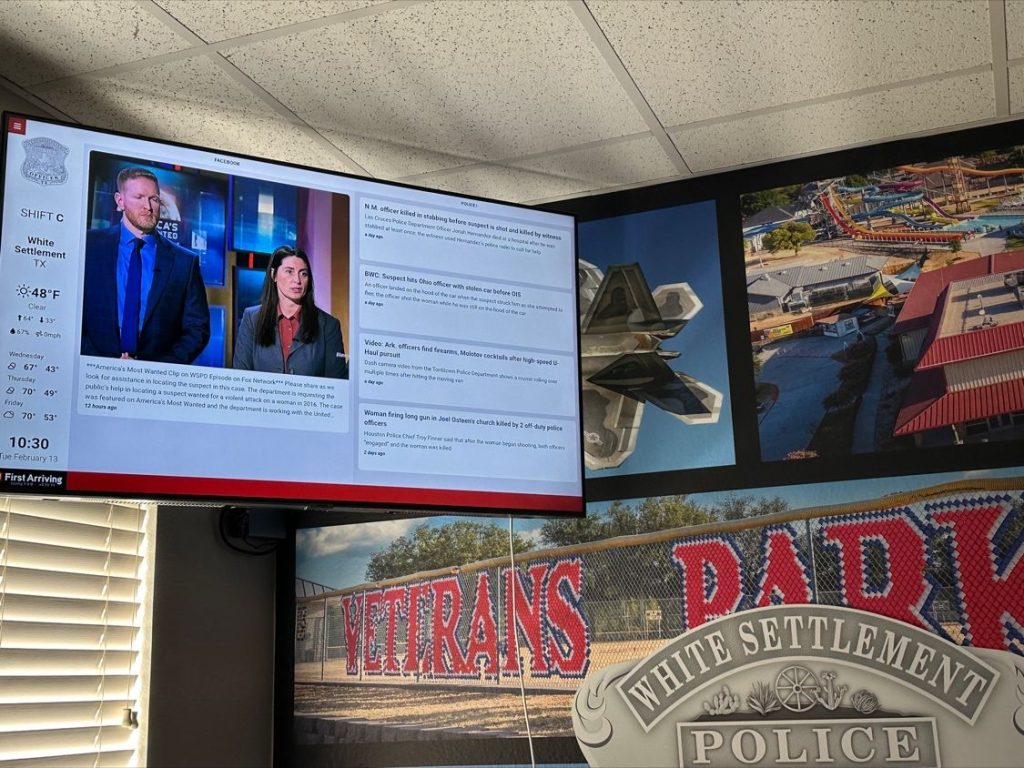
In addition to department events and announcements, they showcase features including the weather and their social media feeds, so officers can stay aware of the department’s content. Sometimes they’ll put a ticker at the bottom, Cook added, to highlight important notes or deadlines. They’re looking into adding additional integrations for metrics, etc., but in the meantime, have been pulling metrics out of their existing record management system and creating their own slides.
The dashboards have become an integral part of the department’s overall internal communication strategy, Cook said, alongside tools including e-mail and a notification platform. “We use all of them,” he said.
“They have their specific uses and purposes, but from a First Arriving standpoint, it’s really to assist the sergeants and corporals to do their briefings.” Everything they need to get across is placed on slides that rotate in the background throughout the briefings, Cook said, reinforcing everything being announced.
Department feedback has been positive, he added.
“So for me it’s been worth the investment, because it’s just another tool in the toolbox, if you will, to showcase the great things that the police department is doing internally. And again, just reinforce the messaging coming out of my office, because I can’t hit every briefing. I can’t always make contact with every employee. But if I’m relying on all of these tools, whether that’s the mass notification system, in-person briefings, emails… I think the digital dashboard solution has a place and purpose for this as well, and that’s how we use it.”
For Cook, lessons learned have included keeping the slides simple with large text, and adapting the dashboard options to fit his department. For example, they initially posted shifts, as fire departments typically do, but decided it wasn’t necessary because their officers already know when they’ll be working.
As both a speaker and an author on communication, Cook suggests that police departments consider dashboards as tools, regardless of their size.
“Many departments, even though they’re small, don’t have face time with their employees all the time, and so First Arriving is a great way to be a force multiplier when it comes to corporate communications because it’s always going to be running in the background,” he said.
“It doesn’t matter what size your agency is—there’s probably a way to integrate this into your buildings and in your operations areas, so that you don’t have employees asking the question, ‘Well I didn’t know that,’ or ‘When did that happen?’”