By Greg Friese | Fire service leadership and operational communication
What is information overload in a fire department?
Information overload in a fire department is not simply receiving too many messages. It is the operational burden created when critical details about staffing, apparatus, policy, and readiness are scattered across too many disconnected systems, channels, and logins — making it harder for leaders to act with confidence.
Critical information is not always missing. More often, it is fragmented across too many places to support clear, confident decision-making.
As a fire department leader, your questions never stop. They sound like this:
- Did you get my email? Did you read it?
- Who still needs to acknowledge the new personal vehicle policy?
- Who is behind on their continuing education?
- Did B-shift move the extrication equipment from Engine 11 to the temporary engine?
- Who is on duty at Station 4 today?
- Are we on target to meet in-service time goals this month?
None of these are unreasonable questions. The problem is that answering them requires logging into five different systems before 0800.
Why do fire departments struggle with too many systems?
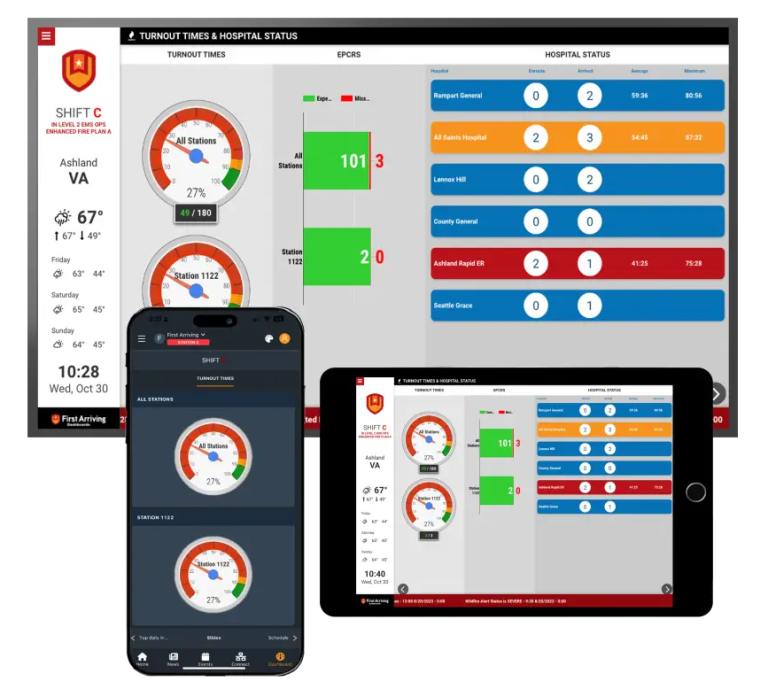
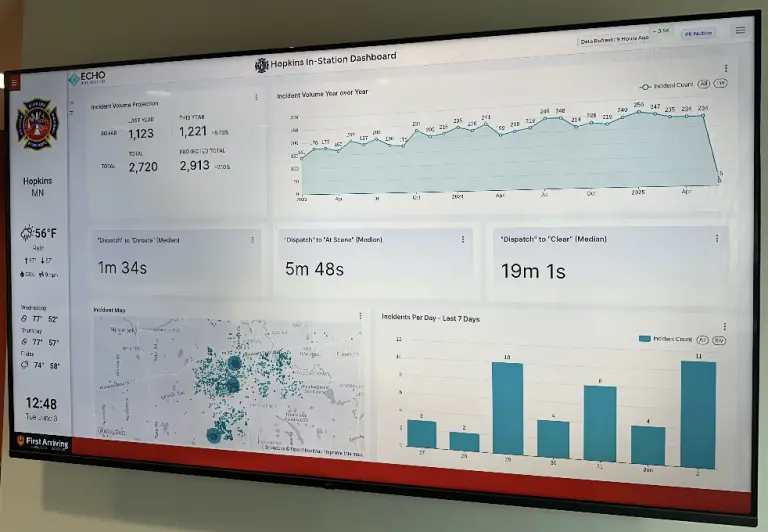
The problem is not a lack of information — it is too much information spread across too many places. In many departments, the details chiefs and command staff need are scattered across CAD, RMS, scheduling platforms, training records, fleet systems, email, and text threads, each requiring a separate login.
A daily check of 5 to 10 systems quickly turns into reviewing dozens of data points, filters, and reports. That fragmented environment creates friction at the start of every shift. It slows decision-making, obscures priorities, and makes it harder to maintain operational readiness without repeated logins, manual workarounds, and time-consuming person-to-person confirmation.
Information overload is the point at which the amount or intensity of information exceeds a person’s ability to process it. In the fire service, that means too many inputs, too many channels, and too many moments when leaders have to stop and piece together a picture that should already be clear.
When does information become an operational burden?
Think about what a chief, battalion chief, or company officer tracks on a normal day — beyond incident response itself. It can include:
- Staffing changes and shift coverage
- Vehicle and apparatus status
- Policy acknowledgment tracking
- Course assignments and training compliance
- Inspection notices and fleet updates
- Road closure alerts affecting response routes
- Department emails, text messages, and app notifications
Some of that information is important. Some is routine. Some is urgent. But when it arrives in disconnected, duplicated streams, all of it competes for the same attention.
A department can have all the information it needs and still struggle to act on it. Critical details that are buried in a long email thread, sitting in a rarely-used app, or visible only to the person who knows where to look are not truly supporting readiness. Leaders end up confirming, searching, logging in, scrolling, and rechecking — instead of leading.
The consequences are easy to underestimate because they look ordinary at first. A message has to be sent twice. Someone says they never saw the update. A crew starts the day with a different understanding than the previous shift. A company officer spends twenty minutes tracking down an answer that should have been immediately visible. None of those moments looks dramatic on its own. Together, they create delay, inconsistency, and uncertainty.
Road closures are a concrete example of the risk
Firefighters rely on timely information about road closures that can change response routes to emergency scenes. Simply forwarding a Public Works email about upcoming road repairs is not adequate when apparatus drivers need to see and be reminded of that information at the start of — and throughout — each shift.
Missing or incomplete information is not just an inconvenience. It is an emergency response safety risk.
What is the hidden readiness risk of information overload?
At its worst, information overload interferes with response readiness. Firefighters who do not share a consistent understanding of policies, procedures, staffing, or apparatus status are more likely to experience confusion, rework, and preventable friction. Leaders may make decisions with only part of the picture.
The hidden risk is not simply that something is missed. It is that people begin making reasonable decisions from incomplete or inconsistent information — and no one realizes it until it matters.
There is also a human cost. Information overload contributes to the feeling of never being caught up, never having a clear view of what matters most, and never being fully confident that the right people have seen the right update. That cognitive burden is not separate from operational performance — it is part of it.
And it takes time. Logging into multiple systems, remembering where information lives, and navigating different interfaces pulls time away from training, equipment checks, physical fitness, recovery, and supervisory work. Multiply that across shifts, stations, and ranks, and the cost adds up quickly.
What Fire Chiefs actually need
Fire chiefs do not need less information. They need clearer visibility into the information that matters most.
Information overload in a fire department is not just high message volume. It is the operational burden of fragmented visibility — what happens when critical information is available somewhere, but not clear enough, current enough, or unified enough to support confident action.
That is why this problem is worth naming clearly. Before a department can reduce information overload, it has to recognize what it actually looks like inside the organization.
Frequently Asked Questions
What causes information overload in fire departments?
The primary cause is fragmented systems. When critical operational data, such as staffing, apparatus, training, and policies, each lives in separate platforms that don’t talk to each other, leaders must manually piece together information that should be immediately visible in one place.
How does information overload affect firefighter safety?
When personnel lack a consistent, up-to-date understanding of operational details like road closures, apparatus status, and staffing assignments, they are more likely to make decisions based on incomplete information. This creates preventable risk during both routine operations and emergency response.
Is information overload the same as getting too many emails?
No. Email volume is just one symptom. Information overload in fire departments is more precisely defined as the operational burden created by fragmented visibility with too many disconnected systems, each requiring separate logins, that together make it harder to maintain situational awareness and act decisively.