Critical information is not always missing. More often, it is scattered across too many systems, channels and logins to support clear, confident decision-making.
As a police chief or sheriff, you know the questions never stop.
Did officers see the updated pursuit policy? Who still needs to acknowledge the revised staff manual? Who is behind on annual training? Did qualification records get uploaded to the RMS? Who is staffing the real-time operations center today? Do we have enough personnel for this weekend’s special event detail? Did night shift see the same briefing information as day shift?
Those are not unusual questions. They are part of running a law enforcement agency. But when the answers are spread across CAD, RMS, scheduling software, training records, policy platforms, fleet systems, email, text threads and specialty applications, leaders are forced to assemble an operational picture one login at a time.
That is what information overload looks like in a police department.
Police information overload is a visibility problem
In many law enforcement agencies, the problem is not a lack of information. The information exists. It is just scattered across too many places.
A chief, sheriff, captain or sergeant may have access to every system needed to answer a question. But access is not the same as visibility.
If staffing information lives in one platform, policy acknowledgments in another portal, vehicle maintenance status in a spreadsheet, training deadlines in a learning management system and incident activity somewhere else, the organization may still struggle to see what matters in time to act on it.
That fragmented information environment creates friction for command staff and patrol personnel. Fragmentation slows decision-making, obscures priorities and makes it harder to maintain operational readiness and situational awareness.
Patrol makes visibility harder
Police departments face a distinct information challenge because much of the workforce is mobile.
Patrol officers, deputies, detectives, school resource officers, traffic units, specialty teams and command staff may spend most of the shift away from headquarters — moving between calls, writing reports, serving warrants, attending court, or preparing for the next assignment.
That means important information cannot depend only on a bulletin board, a hallway conversation, a supervisor’s memory or one more email.
- A patrol officer may need to know about a road closure before leaving the station
- A sergeant may need to confirm staffing for a special event detail
- A detective may need a court schedule change
- A command officer may need to know whether enough personnel have acknowledged a new policy
When the workforce is moving, information has to be visible where people actually work.
When information becomes an operational burden
Beyond normal day-to-day work, a law enforcement leader is tracking staffing changes, arrests and bookings, court appearances, training deadlines, vehicle status, policy acknowledgments, qualification records, road closures, special details, fleet updates, department emails and text messages.
Some of that information is urgent while some is routine. But when it arrives in disconnected streams through logins and notifications, all of it begins to compete for attention. At that point, overload moves from a communications annoyance to an operational problem.
A department can have all the information it needs and still struggle to act on it. Critical information may be buried in a long email thread, sitting in an app that only some personnel check, or visible only to the person who knows where to look.
The consequences, which may look minor and ordinary, start to add up: a message has to be sent twice, an officer says they never saw the update, night shift starts with a different understanding than day shift, a supervisor spends time searching for a basic answer, a deputy starts a detail without the latest traffic plan.
A special event shows the risk
Consider a Friday night football game, downtown festival, parade or visiting VIP security detail.
Staffing assignments may live in the scheduling system. The traffic control plan may be attached to an email. Weather updates may come from emergency management. A last-minute road closure may be posted by public works. Command expectations may have been covered in a supervisor meeting.
All that information is important and useful, but if it is scattered across systems and conversations, personnel may begin the operation with uneven awareness. One officer knows the staging location. Another knows the road closure. A supervisor knows the revised traffic plan. Dispatch knows the expected crowd size. Command staff know the contingency plan — but no one has the complete picture before they need it.
The officer safety connection
Information overload can affect officer safety when personnel do not share the same current understanding of road closures, high-risk address notes, BOLOs, warrant service plans, special event assignments, severe weather, school safety updates and staffing changes.
Officers making decisions with incomplete or inconsistent information have less situational awareness, which increases risk. Chiefs, sheriffs and supervisors need confidence that personnel are working from the same current operating picture, especially across shifts, units and locations.
The human cost of fragmented information
The human cost of information overload is the feeling of never being caught up, never having a clear view of what matters most and never being fully confident that the right people have seen the right update.
The cognitive burden of every extra login, repeated search, duplicate message and unclear notification takes time and attention away from the work that matters: patrol, investigations, supervision, training, physical fitness, recovery and community engagement.
Multiply that across shifts, divisions and ranks, and the impact adds up quickly.
What police leaders need instead
Police chiefs and sheriffs need information, but what they really need is clearer visibility into unified information that supports confident action.
A better information environment:
- Shows personnel what matters without forcing them to chase it across disconnected systems
- Makes important updates visible across shifts
- Supports role-specific awareness
- Gives supervisors a clearer operational picture
- Identifies gaps before they become problems
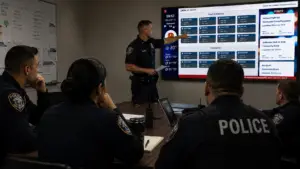
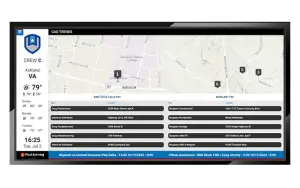
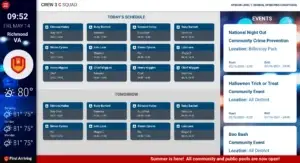
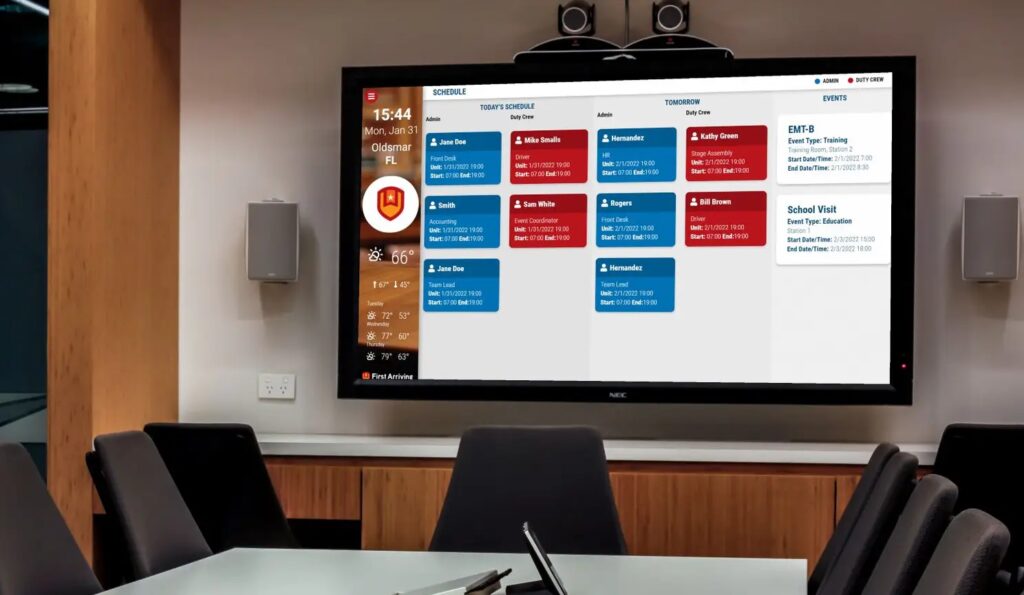
That is the value of a real-time operational dashboard for law enforcement agencies. Dashboards consolidate mission-critical information from key systems and display it where personnel can use it: in headquarters, substations, briefing rooms, real-time crime centers, command areas and mobile devices.
Frequently asked questions
What is information overload in a police department?
Information overload in a police department is the operational burden created when critical information is spread across too many systems, channels, logins and informal communication paths. The issue is not just message volume — it is the lack of clear, current visibility into the information chiefs, sheriffs, supervisors and personnel need to act with confidence.
Why do law enforcement agencies struggle with information overload?
Law enforcement agencies rely on many different systems — CAD, RMS, scheduling, training records, policy management, fleet systems, email, text threads and specialty applications. When those systems do not create a unified operational picture, leaders and personnel have to manually piece together information that should be easier to see.
How does information overload affect officer safety?
Information overload can affect officer safety when personnel do not share the same current understanding of road closures, high-risk address notes, BOLOs, warrant plans, staffing changes, special details or policy updates. Officers may make reasonable decisions, but those decisions may be based on incomplete or inconsistent information.
Is information overload the same as getting too many emails?
No. Email volume is one symptom, but not the full problem. In law enforcement, information overload is more accurately understood as fragmented visibility — critical information may exist, but it is spread across too many systems and channels to reliably support situational awareness and timely decision-making.
How can police departments reduce information overload?
Police departments can reduce information overload by making mission-critical information more visible, current and role-relevant. Start by identifying the information personnel repeatedly search for, miss or ask about, then bring those updates into a clearer operational view that supports chiefs, sheriffs, supervisors and personnel across shifts and assignments.
Schedule a live demo to see how First Arriving can help your law enforcement agency →