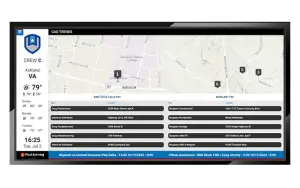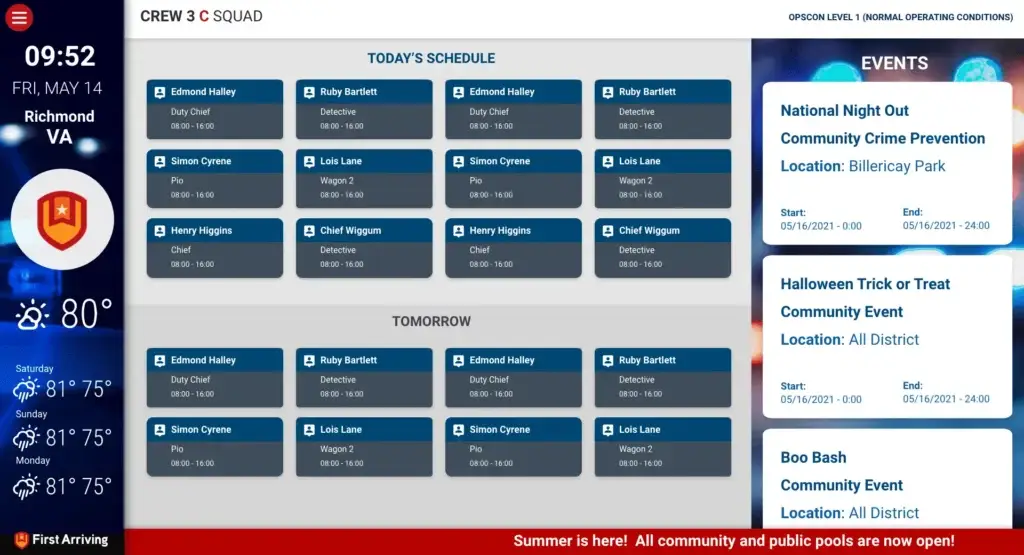
Most law enforcement agencies have an information overload problem. They may not realize how much it is already affecting readiness, supervision and decision-making.
Critical operational information is often scattered across emails, texts, CAD, RMS, knowledge management systems, real-time crime center bulletins, scheduling software, fleet management software, training platforms and bulletin boards.
The result is fragmented visibility, slower decisions and daily friction that chips away at situational awareness.
The briefing gap is where overload shows up first
In law enforcement, information overload often shows up as a briefing gap.
One shift hears an update in person. Another receives it by email. A supervisor mentions it in a text thread. A bulletin is posted at the station. A training deadline lives on another platform. A fleet issue is known by one sergeant but not another.
None of those channels are necessarily wrong. The problem is that they do not always create a shared operational picture.
For police chiefs, sheriffs and command staff, the question is not only, “Was the information sent?” The additional question is, “Do the right people have the same current understanding before they act?”
If the answer is no, the agency has a communication problem and an operational visibility problem.
What is information overload in law enforcement?
Information overload in a law enforcement agency is not simply receiving too many messages. It is the operational burden created when critical updates are spread across too many systems, too many channels and too many logins.
Staffing assignments, court appearances, training deadlines, policy acknowledgments, vehicle status, BOLOs, real-time crime center bulletins, special event plans, high-risk address notes and daily operational priorities may all be available somewhere.
But “available somewhere” is not enough when officers, deputies and supervisors need a clear picture before roll call, before leaving the station or before making a decision in the field.
Take the police department information overload assessment
The assessment includes 10 questions scored on a five-point scale — about three minutes to complete. Your results will show whether your information environment is manageable, strained or high risk, and can help identify where communication friction may already be affecting readiness, coordination and decision-making.
How severe is information overload in your department?
Police chiefs rarely lack information. The real challenge is that critical operational information is often scattered across too many systems, emails, texts, spreadsheets and dashboards. This assessment will help you evaluate whether your department’s information environment is manageable, strained or high risk.
Your results
Top problem areas
Want a clearer operational picture?
What do your results mean?
Manageable: 0–13
Your agency’s communication practices are generally supporting readiness, supervision and decision-making. Some friction may still exist across shifts, units or systems, but critical information is usually visible enough to support action.
Strained: 14–26
Fragmented systems, inconsistent briefing practices or too much untargeted messaging may be making it harder for personnel to maintain a shared operational picture. Leaders may be spending too much time confirming whether the right people saw the right update.
High risk: 27–40
Your information environment may be interfering with command visibility, situational awareness and readiness. Leaders may be spending too much time manually assembling the operational picture while officers and deputies receive too much noise and not enough clarity.
What should you do if your department is strained or high risk?
If your results point to a strained or high-risk information environment, the answer is not simply to send fewer emails or add another app. The bigger issue is visibility.
Information overload is often less about the total amount of information and more about how scattered, inconsistent or difficult it is to use. Police chiefs and sheriffs who improve visibility put themselves in a better position to strengthen readiness, improve alignment and reduce daily friction across the department.
Book a live demo to see how First Arriving can help your law enforcement agency reduce information overload and improve situational awareness.
Frequently asked questions
What does the assessment measure?
The assessment measures how clearly critical information moves through your agency. It looks at message volume, system fragmentation, briefing consistency, priority clarity, role targeting and governance.
Who should take the assessment?
Police chiefs, sheriffs, command staff, patrol commanders, administrative captains, real-time crime center leaders and supervisors responsible for communication, readiness or daily operations.
What are signs of information overload in a police department?
Common signs include repeated emails, inconsistent roll-call updates, missed policy acknowledgments, confusion across shifts, too many separate logins, outdated bulletin boards, stale alerts and supervisors spending too much time looking for basic operational answers.
Can information overload affect officer safety?
Yes. When critical updates are missed, delayed or misunderstood, personnel may lack a shared understanding of road closures, high-risk addresses, BOLOs, special event plans, staffing changes or policy updates that affect situational awareness.
Is information overload only a problem for large agencies?
No. Smaller agencies may have fewer personnel, but they still rely on multiple systems for scheduling, policy management, training, fleet tracking, RMS and CAD. Fragmentation can affect agencies of any size.
What should I do after taking the assessment?
Review your top problem areas, identify where personnel are repeatedly searching for or missing information, and look for ways to make mission-critical updates more visible, current and role-relevant. If results show a strained or high-risk environment, the next step is a clearer operational view — not another app or email list.