What Does “Operational Readiness” Mean for an EMS Agency?
Operational readiness in EMS means that at any given moment, leadership and crews can answer these questions without making a phone call or pulling a report:
- Which units are available right now?
- Which crew members are on shift and fully certified for their role?
- What is the current equipment and vehicle status?
- Are there any active hospital diversions affecting where patients can be transported?
- What does call volume look like, and where are resources concentrated?
When the answer to any of these questions requires effort to find — checking multiple systems, sending an email, calling a supervisor — that’s friction that slows operations and increases risk.
The Information Problems EMS Agencies Share
Fragmented system landscape. CAD data lives in one place, staffing in another, certifications in a third, equipment checks in a paper log or separate app. Getting a complete operational picture requires logging into multiple systems.
Shift change information gaps. Critical updates — a unit out of service, a crew member who called out, a new protocol update — don’t reliably reach incoming crews.
Leadership visibility without real-time data. Directors and supervisors who aren’t on the floor have to request information rather than observe it. By the time a report is generated, the operational picture has already changed.
Certification compliance drift. EMS certification requirements are rigorous — paramedic licenses, ACLS, PALS, and others all have renewal cycles. When tracking is manual and distributed, expirations get missed.
How Real-Time Dashboards Address Each of These
Unit Availability and CAD Integration
The most immediate operational value for EMS agencies is live unit status pulled directly from the CAD system. Station screens and supervisor dashboards show:
- Which units are available, on a call, or out of service
- Current call assignments and geographic distribution
- Response time metrics for recent calls
- Unit locations on a live map
This gives supervisors the situational awareness to manage resources without relying on radio traffic alone — and gives crews a live picture of what’s happening across the agency at shift start.
Crew and Staffing Visibility
Dashboard platforms that integrate with scheduling systems surface real-time staffing data: who is on duty by unit and station, upcoming vacancies or unfilled shifts, and on-call availability. For multi-station EMS agencies, this visibility across all locations without making calls or checking a separate system is a significant operational improvement.
Certification and Compliance Tracking
EMS certification tracking on a dashboard works by pulling data from the LMS or credentialing system and displaying current compliance status in a visible, color-coded format. Supervisors no longer wait for the training officer to flag an expiring credential. Crew members see their own upcoming renewals. The training officer has a department-wide view without running a report.
Equipment and Vehicle Readiness
EMS agencies integrating fleet and equipment management systems with their dashboards display vehicle service status, upcoming maintenance, equipment check completion status, and medical supply inventory (where integrated). This moves equipment readiness from a paper check in a binder to a visible, shared operational metric.
Hospital Diversion Awareness
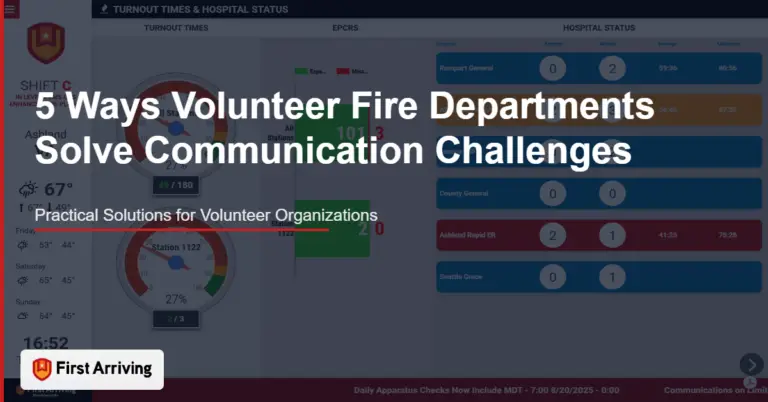
For EMS agencies operating in regions where hospital diversion affects transport decisions, some deployments integrate with regional EMResource or similar systems to surface current hospital status directly on the station display — which facilities are on diversion, which have long wait times — giving crews passive awareness before they’re in the middle of a call.
What EMS Leaders Report After Deployment
EMS directors and supervisors who have deployed dashboard platforms consistently describe these outcomes:
Faster awareness of operational issues. Problems that used to be reported reactively — a unit going out of service, a staffing gap — become visible proactively.
Reduced administrative overhead. Fewer emails, fewer check-in calls, fewer status requests. The information is visible without anyone having to push it.
Better shift transitions. Incoming crews start each shift with a clear picture of unit status, staffing, and any active operational issues.
Improved certification compliance. When crew members see their own upcoming expirations on the station screen, they address them without being reminded by a supervisor.
Frequently Asked Questions
Does First Arriving integrate with our CAD system? First Arriving integrates with most major CAD platforms used by EMS agencies. Integration compatibility can be confirmed during the evaluation process.
How does this work for interfacility transport agencies, not just 911? The platform is adaptable. Interfacility agencies typically focus on unit availability, trip management, and crew certification visibility.
Can this work alongside our existing CAD and RMS systems without replacing them? Yes. First Arriving is a visibility layer that surfaces data from your existing systems — it doesn’t replace them.
What about HIPAA considerations? Dashboard displays show operational and crew-readiness data, not patient information. PHI is not a component of standard dashboard deployments.
How long does it take to get an EMS agency up and running? Most deployments are operationally active within 2–4 weeks.
Operational readiness in EMS isn’t a fixed state — it’s a real-time condition that changes with every call, every shift, and every equipment check. Agencies that can see that condition continuously make better decisions than those that have to go looking for the information.