The Policy Rollout Toolkit
A policy sticks when the rollout is treated as its own project. Talk to affected members before announcing it, triage the change by urgency, explain what changed and why in plain language, give people a chance to ask questions, and confirm understanding with more than a signature, before the change takes effect for anything safety-critical.

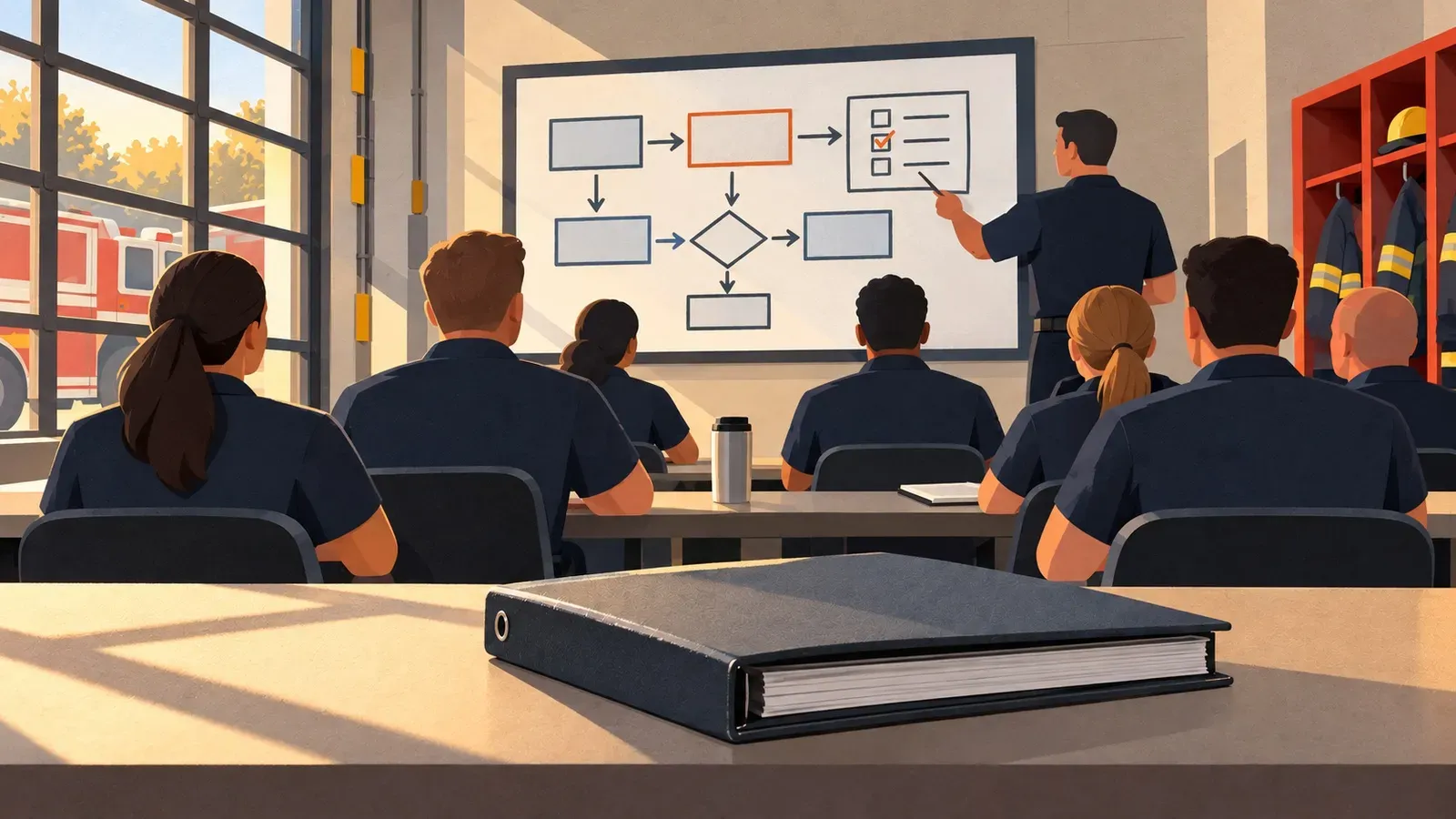
How to earn buy-in before a change is announced and roll out policies, SOGs and protocols so fire, EMS and police personnel actually understand them.
I've sat in the room where a policy gets written. Careful language. Legal review. Input from three or four people who know the subject cold. Everyone leaves satisfied that the document is right.
Then it gets posted to a shared drive, mentioned once at a staff meeting, and forgotten. Six months later something goes wrong, someone pulls up the policy, and half the department didn't know it existed. The policy was fine. The rollout was the failure, and it's one of the most common failures in public safety, across fire, EMS and police alike.
There's a second way changes fail, and it starts earlier. A memo goes up on the board, an email goes out, or a new officer stands in front of the crew and explains that starting next month things will be done differently. The room goes quiet in a way that has nothing to do with agreement. Firehouses and squad rooms don't resist change because members are stubborn. They resist it because they run on trust and shared experience, and a memo respects neither one.
This toolkit covers both halves: earning buy-in before a change is announced, and rolling it out so it actually sticks. It includes a policy triage list, a pre-announcement checklist, a rollout plan template and a final readiness test.
Writing the policy is the easy part
Departments spend enormous time getting the language right and almost no time deciding how the language will reach the people who have to follow it. That's backwards. A well-written policy nobody reads carefully is worse than a plainly written one everyone understands, because the well-written one creates a false sense that the job is done. Publishing a document is not the same as communicating a change.
Every discipline has the same gap, dressed differently. A police department issues a general order. A fire department revises an SOP or SOG. An EMS agency updates a protocol. The paperwork, approval chain and oversight body differ, but the problem is identical: a change was approved above the floor, and now it has to reach every shift, station, squad and crew in a form they'll actually absorb before it matters on a call.
Accreditation and audit processes can make this worse in a subtle way. They reward having a policy on file and a signature confirming it was distributed. They don't measure whether the person who signed understood what changed. A department can be fully compliant on paper and still have a floor with no real idea what the new use of force policy, the new protocol for withholding resuscitation or the new mayday SOG actually says. Compliance and comprehension aren't the same thing, and treating them as the same is how policies end up being read for the first time during an internal affairs interview or a bad outcome review.
Step 1: Understand the resistance before you address it
Every experienced member has a story about a change that was supposed to fix something and created new problems instead, because whoever introduced it never asked the people doing the job what the job required. That history gets applied to you by default, before you've said a word.
There's also respect. Members who have done something a certain way for years aren't being asked whether the new approach might be better. They're being told it will be different. Even when the new approach really is better, being told instead of asked reads as a judgment on everything they've done so far.
And some resistance is earned skepticism. Plenty of initiatives arrive with enthusiasm and disappear a year later once the person who pushed them moves on. Members who've been around long enough have learned not to invest in something that might not last.
None of that means the resistance should win. It means it deserves to be understood before it can be addressed.
Step 2: Do the culture work before the announcement
The mistake is treating change as purely a communication problem, something you can solve by explaining the new policy clearly enough or often enough. Communication matters, but it's the last step, not the first. The real work happens in conversations long before the announcement.
There's a difference between winning buy-in and running over objections until people stop raising them. The second might get compliance. It won't get commitment, and it will make the next change even harder.
Step 3: Triage the change
A policy change deserves the same discipline as any other communication that matters. Before it goes out, decide who needs to know, how urgently, and what proof you need that they absorbed it. A change to the uniform policy and a change to the deadly force policy should never travel through the same process at the same speed.
Step 4: Roll it out in three parts, because a memo is not training
The instinct in most agencies is to write the change, distribute the memo and consider the job finished. That treats a policy change like an announcement instead of what it is: new information someone has to retain and apply under pressure, sometimes months after reading it once.
A workable rollout has three parts:
- A plain-language explanation of what changed and why, separate from the formal policy text. Officers, medics and firefighters don't need the legal phrasing to understand the practical difference in what they're expected to do.
- A moment to ask questions and get real answers, whether that's roll call, a shift briefing, a squad meeting or a short training session. A policy that only exists as a document invites people to interpret it on their own, and that's where inconsistent enforcement and liability both start.
- Confirmation that goes beyond a signature on a distribution list. A brief scenario-based question, a supervisor sign-off after a conversation, or a short quiz tied to the training record all confirm understanding better than an email read receipt.
Don't let the rollout outrun the explanation. Personnel will follow a rule they don't understand for a while, out of habit and respect for the chain of command. That compliance erodes fast if people believe the rule is arbitrary. Explaining the reasoning, the incident or the liability concern behind the change costs almost nothing and buys durable buy-in. It also cuts down on the workaround culture that grows around any rule people think is pointless.
This is where the first-line supervisor matters more than the policy author ever will. A sergeant, company officer or field supervisor who can explain a change in their own words, in the moment someone asks, does more for adoption than another paragraph in the document.
Rollout plan template
Fill this out for every policy change before it goes out:
- Policy or order: name, number and effective date.
- Category: safety-critical, operational or administrative.
- What changed: two or three plain-language sentences.
- Why it changed: the incident, risk, liability concern or operational need behind it.
- Who it affects: all personnel, or specific stations, shifts, squads or roles.
- Who was consulted: members and supervisors who gave input, and what changed because of it.
- Supervisor briefing: date, and who confirms supervisors can explain it.
- Where questions get answered: roll call, briefing, squad meeting or training session, with dates covering every shift.
- Training required: yes or no, and by when.
- Confirmation method: scenario question, supervisor sign-off, quiz or acknowledgment.
- Confirmation deadline: for safety-critical changes, before the policy takes effect operationally.
- Follow-up: who checks understanding a month later, and how.
Step 5: Build confirmation in, not on top
Retrofitting confirmation after the fact is expensive and unreliable. Chasing down forty signatures three weeks after a policy took effect tells you almost nothing about whether people understood it when it mattered. Build the confirmation step into the rollout: the training happens, then the acknowledgment happens, in that order, close together.
For safety-critical changes, confirmation should happen before the policy takes effect operationally, not after. It's a small sequencing decision that gets skipped constantly under time pressure, and it's exactly the sequencing that protects both your personnel and your agency when someone later asks who knew what, and when.
Step 6: Follow through visibly
If members raised a concern during the process and you adjusted the plan because of it, say so. That single act tells the room that input wasn't a formality, and it makes the next difficult conversation easier because people believe their voice actually moves something.
Keep following through after launch, too. Check in with the pilot group and the members who pushed back. If a real problem surfaces on an actual call, fix it and tell people you did.
The real test
The real test of a policy rollout comes a month later: could you stop any member on any shift, in any station or squad, and get a correct answer to what changed and why?
If you can't get correct answers with confidence, the policy exists on paper and nowhere else that matters.
The changes that stick are rarely the ones announced with the most confidence. They're the ones introduced with enough patience that the people affected helped shape them, enough honesty that nobody was surprised by the cost, and enough follow-through that members believed leadership meant what it said. Write the policy carefully. Then spend just as much care getting it into people's heads before the day it gets tested.
First Arriving helps with the confirmation side: policy documents and training in one place, messaging targeted by station, division and role, and required acknowledgments so you know who's read what.
Frequently asked questions
Why do new policies fail to stick?
Usually because the rollout was treated as distribution rather than communication. A policy posted to a shared drive and mentioned once is rarely understood, especially if members weren't told why it changed or given a chance to ask questions.
Is a signed acknowledgment enough to confirm a policy was understood?
No. A signature confirms distribution, not comprehension. Scenario-based questions, a supervisor sign-off after a conversation, or a short quiz tied to the training record are better evidence of understanding.
When should confirmation happen for a safety-critical policy change?
Before the policy takes effect operationally. Training should happen first, followed closely by acknowledgment, so personnel are not expected to act on a change they haven't absorbed.
About the author
Dave Iannone
Founder & Chief Product Officer
Founder of Firehouse.com and Firefighter Nation, a veteran entrepreneur and lifelong first responder and leader.