The Group Text Is Not a Communications Plan
A group text or whiteboard is not a communications plan because neither confirms that information reached anyone. A real plan sorts information by urgency (safety-critical, operational, administrative, cultural), sends each type through a channel suited to it on a predictable cadence, and tracks acknowledgment for anything that affects safety, compliance or operations.

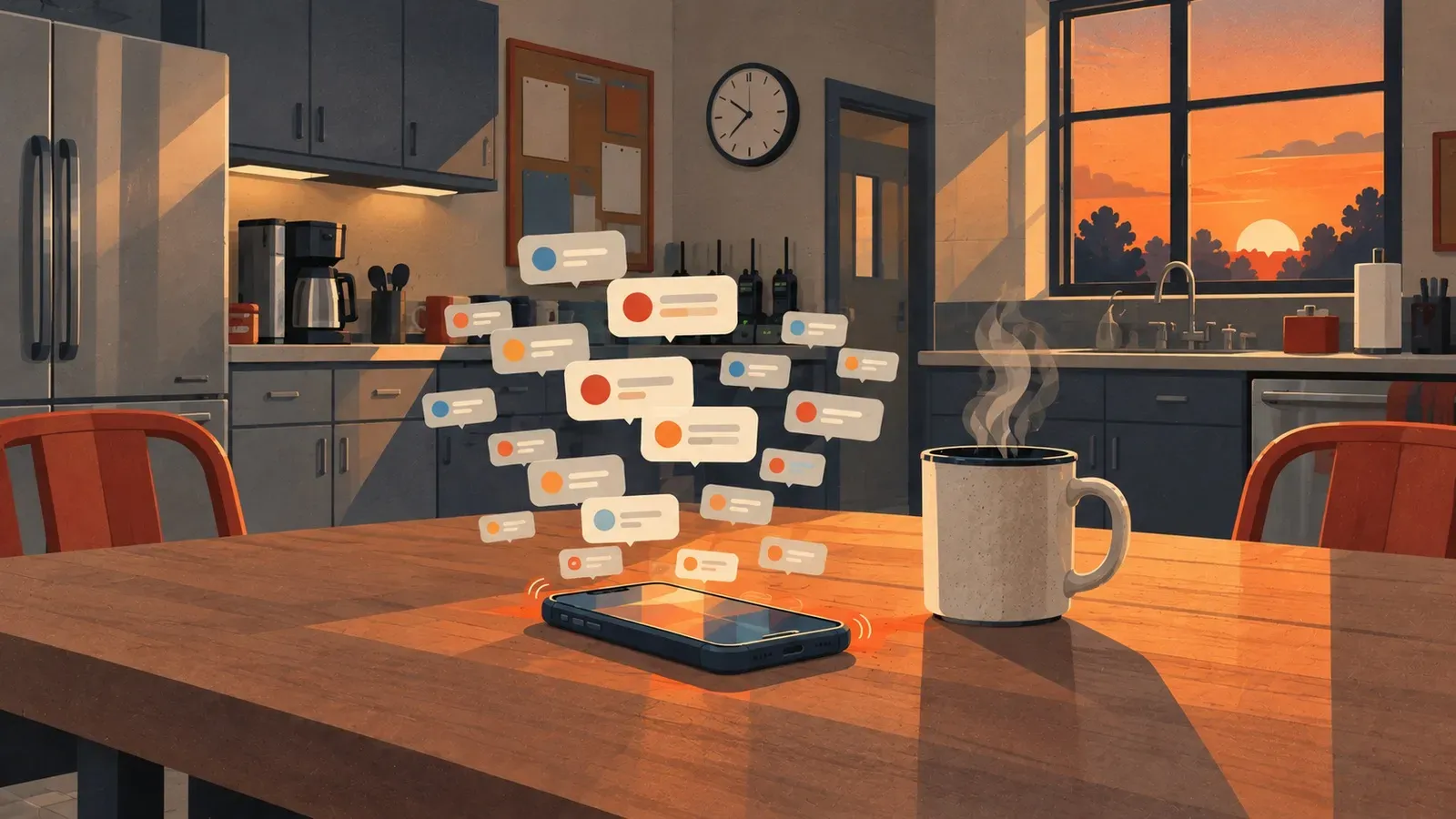
If your department's communications plan is a group text and a whiteboard nobody reads, you don't have a plan. You have a habit, and it is failing you.
Ask most chiefs how information gets to the membership and you will hear some version of the same answer. There is a group text for the officers. There is a whiteboard by the kitchen. There is an email list that half the department has muted. And there is the assumption that whatever matters will eventually surface somewhere.
That is hoping, not planning.
I have watched departments lose track of schedule changes, miss safety notices, forget about mandatory training and show up to the wrong staging area. Not because nobody sent the information, but because it was sent into a system built for casual conversation, not reliable delivery. A group text is a good tool for coordinating who is bringing the food on Sunday. It is a bad tool for telling forty people across three shifts that a policy changed.
Why Information Dies in a Group Text
A group text has no structure. Messages scroll past each other. Important notices get buried under jokes, logistics questions and the inevitable thread that wanders off topic. There is no way to mark something as read, no way to confirm who saw it, and no way to find it again two weeks later when someone asks what the policy actually says.
It also does not scale. A text chain that works for twelve officers becomes unmanageable at forty members, and it becomes counterproductive once the chatter outweighs the content and people start muting it. Once that happens, you have lost your communications system and nobody has told you.
The whiteboard has a different problem. It depends on physical presence. A member who is not at the station the day something gets written down never sees it. It depends on someone remembering to erase old information, and on the handwriting being legible enough for the next shift to read correctly. I have seen an incoming crew misread a duty change on a board because two similar-looking names were abbreviated the same way.
Both tools share the same root failure. They were never designed to guarantee that information reaches people. They were designed to let people share something in the moment, with whoever happens to be looking. That is fine for casual coordination. It is not fine for anything that affects safety, compliance or operations.
Sort Information Before You Send It
Before you fix how information moves, sort what kind of information you are actually moving. Not everything belongs in the same channel, and treating every message the same way is part of why the important ones get lost.
Roughly, department information falls into a few categories:
- Safety-critical and time-sensitive. A road closure affecting response, an equipment recall, a change to standard operating guidelines that takes effect immediately.
- Operational and recurring. Schedules, staffing needs, apparatus status, training assignments.
- Administrative. Certification deadlines, benefit enrollment windows, policy updates that take effect over time.
- Cultural and morale. Recognition, milestones, community events, new member introductions.
Each of these has a different tolerance for delay and a different need for confirmation. A safety notice needs acknowledgment, not just visibility. A cultural announcement does not need to interrupt anyone's shift. When every category runs through the same group text at the same volume, urgent items get the same weight as trivial ones, and people stop being able to tell the difference.
Build a Cadence, Not a Flood
A department does not need more messages. It needs a rhythm people can predict and trust.
Set a cadence for what goes out and when. Daily operational information, such as staffing and schedule notices, can run on its own cycle. Weekly or monthly items, like training reminders and administrative deadlines, belong on a slower cycle so they do not compete with daily traffic. Safety-critical information should never wait for a scheduled cycle. It needs its own immediate path with confirmation built in.
The goal is that a member knows roughly where to look for a given kind of information, and roughly when to expect it. Predictability builds trust. Nobody builds the habit of checking a source they cannot predict.
Make Reach the Standard, Not Just Send
Sending a message is not the same as it being received, and receiving it is not the same as understanding it. A real internal communications structure accounts for the gap between those three things.
That means having a way to confirm that safety-critical and policy information was actually seen, rather than assuming it was seen because it was posted somewhere. It means having a channel that does not depend on someone being physically present at the station, since shift work and volunteer schedules guarantee that a meaningful share of your personnel will not be there when something is announced. And it means giving people a place to go back and check something later, rather than relying on their memory of a text thread from three weeks ago.
None of this requires elaborate technology. It requires deciding, deliberately, which information needs confirmation, and building a habit of checking a small number of reliable sources instead of an unpredictable number of unreliable ones.
What This Looks Like in Practice
A workable structure usually has three parts:
- A shared, always-visible source for operational information that does not depend on anyone checking their phone, so people passing through the station absorb it as part of their environment.
- A confirmed channel for anything safety-critical or policy-related, where acknowledgment is tracked rather than assumed.
- A lighter channel for cultural and morale content that keeps a department feeling like a department, separated from operational and safety traffic so nothing gets lost in either direction.
None of the three replaces face-to-face communication, roll call or a well-run officer meeting. They support it, by making sure the information discussed in those settings does not evaporate the moment people leave the room.
Stop Treating Convenience as a Plan
A group text and a whiteboard survive because they are convenient, not because they work. They require no setup, no training and no decision about what matters most. That convenience is exactly why they fail the moment your department gets busy, your membership outgrows what a text chain can handle, or the information actually matters.
A real communications plan does not need to be complicated. It needs to sort information by urgency, deliver it through a channel suited to that urgency, and confirm that it reached the people who needed it. If you cannot say with confidence whether every member on every shift saw last week's policy change, you do not have a communications plan. You have a habit that has not failed badly enough yet to force a change.
Fix it before it does.
At First Arriving, we built our platform around that same structure: station dashboards that keep operational information in view, critical messages with required acknowledgments so you know who has read what, and targeted messaging by station, division and role. It works on the station TV, the desktop and the iOS and Android app.
Frequently asked questions
Why shouldn't a fire department rely on a group text for important notices?
A group text has no read confirmation, buries important notices under casual chatter and is hard to search later. As it grows, members tend to mute it, which cuts them off from the information that matters.
What categories should department information be sorted into?
A practical split is safety-critical and time-sensitive, operational and recurring, administrative, and cultural or morale. Each has a different tolerance for delay and a different need for confirmation.
Which messages need acknowledgment?
Safety-critical and policy information should be confirmed as seen rather than assumed. Cultural and morale content usually does not need acknowledgment.
About the author
Dave Iannone
Founder & Chief Product Officer
Founder of Firehouse.com and Firefighter Nation, a veteran entrepreneur and lifelong first responder and leader.